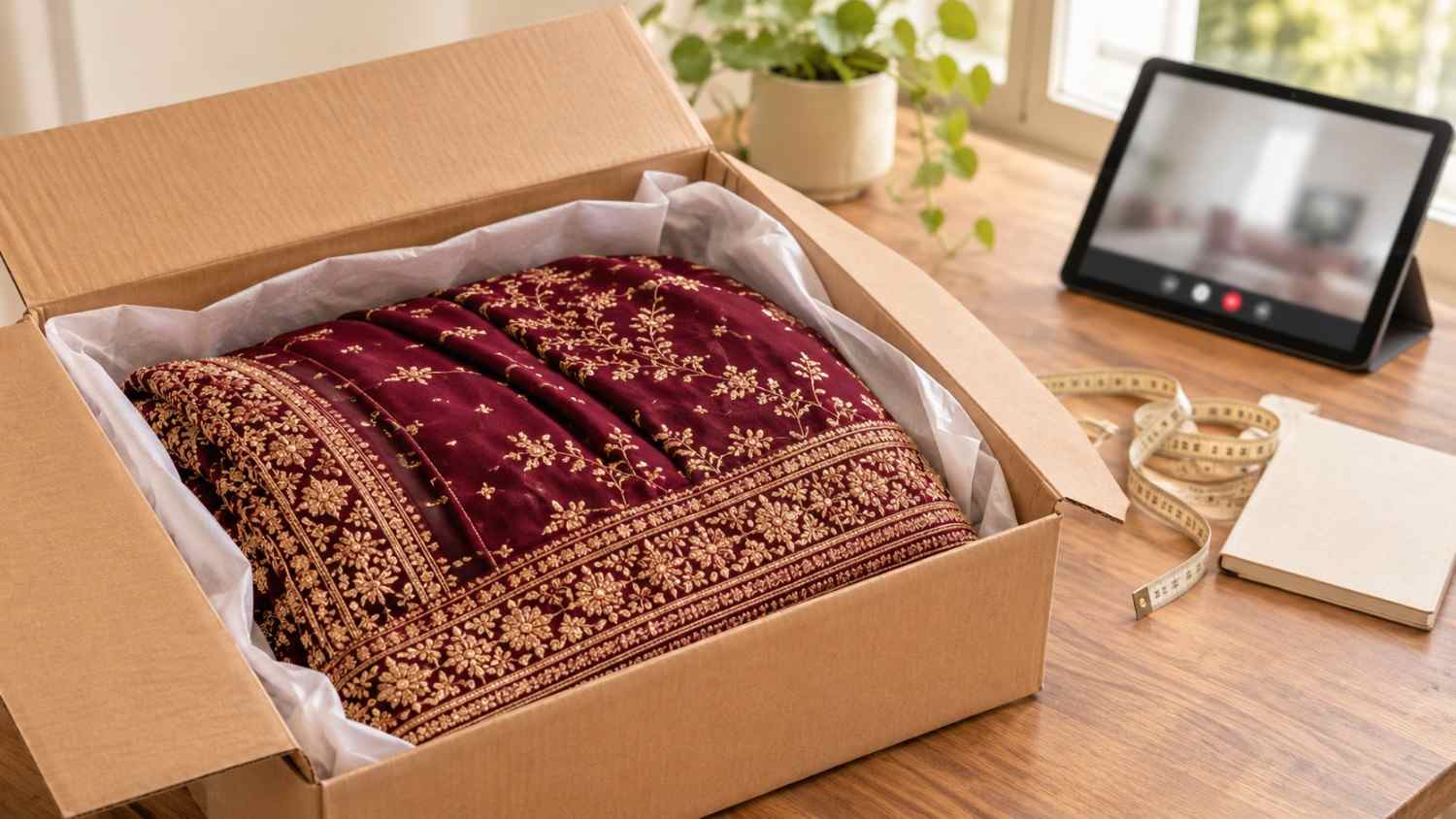
Choose by hours, not by label. A long, hot or active function suits light to medium embroidery placed where people look. A short, cool, indoor function with plenty of photographs can carry medium to heavy work. If you are unsure, a safe starting point is richer work on the blouse, border and dupatta edge, with a quieter skirt.
“Heavy” and “light” describe how much handwork a lehenga carries. What you actually carry depends just as much on the build underneath: base fabric, layers, lining, can-can, waistband and dupatta. A heavily embroidered lehenga on a well-planned build can be wearable. A lightly embroidered one on a bulky build can be tiring.
What “heavy” and “light” actually mean
Boutiques use “heavy work” and “light work”, and “heavy trousseau” and “light trousseau”, as shorthand. There is no standard behind them, so it helps to split the idea into four separate choices:
- Density: how much of the visible surface is worked.
- Placement: where the work sits: blouse, border, dupatta edge, skirt field, back.
- Technique: raised metal work such as zardozi and dabka, appliquéd gota patti, silk-thread resham, aari, mirror work. Our bridal embroidery guide explains how each is made and how to judge it.
- Build: the base fabric, number of layers, lining, can-can (the underskirt that gives volume), waistband and dupatta.
Here, “light” means less embroidery. It does not mean pastel, and it does not automatically mean lightweight or cheap. Many “light lehenga” pages online are about colour, so check which one you are reading.
A practical way to talk about density (working definitions, not an industry standard):
| Tier | How much of the visible surface is worked | Where the work usually sits |
|---|---|---|
| Light | Roughly a third or less | Borders, scattered motifs, blouse accents |
| Medium | Roughly a third to two-thirds | Dense blouse and border, partial skirt work, worked dupatta edge |
| Heavy | More than about two-thirds | Dense work across skirt, blouse and often the dupatta |
When you visit a boutique, ask to see a sample of what it means by each.
Heavy embroidery vs a heavy lehenga
Embroidery does add weight. Our embroidery guide places zardozi and dabka at the heavy end, gota patti and resham at the lighter end, and aari in between, depending on density.
But the skirt also carries the base fabric, lining, any supporting layers, the can-can, the waistband and the dupatta. Fabric weight is measured in GSM (grams per square metre), and “silk” covers very different weights. Dense work usually needs a stronger base under it, so heavy embroidery often brings extra layers with it.
An illustration (not measured data):
- Outfit A: medium embroidery on two light organza layers, a breathable lining and a modest can-can.
- Outfit B: lighter embroidery on five layers over a canvas lining with a stiff can-can.
B can easily feel heavier and hotter than A despite less embroidery. Our silk vs organza guide makes the same point about layers and lining, and covers which fabrics support dense work.
When you compare two lehengas, compare the whole build, not just the amount of embroidery. A double dupatta, a heavily worked blouse and a statement necklace add to the total even when the skirt is light.
How heavy is a bridal lehenga?
There is no reliable single number. Figures online run from about 1 kg to 18 kg, and they disagree because they count different things. These are published claims as of October 2026, and we have not independently verified them:
- Panache Haute Couture gives 12–18 kg for a heavy bridal lehenga in one place, 8–18 kg in a table further down the same page, and 5–18 kg as typical in its FAQ.
- Weddingkart says a fully worked skirt alone can weigh 8–15 kg.
- Busy Brides says a heavily embellished lehenga can weigh 10–13 kg or more.
- Falguni Shane Peacock’s blog gives 3–10 kg for a bridal lehenga.
- Bullion Knot says brides who manage best typically wear 6–8 kg rather than 12–15 kg. This is anecdotal.
- Some marketplace sellers list “heavy” party-wear sets at roughly 1 to 1.3 kg.
In the pages we reviewed, few say whether the figure covers the skirt alone or the full set, how it was measured, or what base fabric and layers were used. The word “heavy” is also used for how an outfit looks, not only for what it weighs.
How to read a weight you are quoted
- Ask what it includes: skirt only, or skirt, blouse, dupatta and can-can.
- Ask whether it was weighed on a scale or estimated.
- Ask about the build: base fabric, layers, lining, canvas.
- Compare like with like.
Example (numbers invented to show the arithmetic): Boutique X quotes 8 kg for the full set, including can-can and dupatta. Boutique Y quotes 6 kg for the skirt alone. If Y’s can-can and dupatta add another 3 kg, its comparable figure is 9 kg, heavier than X.
Before approving a final design, ask to hold the lehenga and try it on with everything in place. Our buying guide recommends this for any bridal lehenga.
How heavy and light embroidery look: distance, light and camera
Embroidery that looks rich at arm’s length can read differently from across a hall or in a photograph. No page can tell you in advance how your outfit will look, so test it at three distances:
- Arm’s length: check stitch quality, relief and finishing.
- Across the room: check whether the colour contrast, motif size and border still show, or whether fine tone-on-tone work fades.
- Camera: photograph the sample, or a swatch with the work on it, in light similar to your venue. Check whether the detail survives and whether metallics catch light in ways you like.
Mirror work and sequins are often chosen for evening and garba because they catch light as you move. Whether that suits you is a judgement to make in front of the real fabric, not from a description.
Comfort over a long day
Is a heavy lehenga uncomfortable? It can be, but how much depends on the build, the waistband fit, the temperature and how many hours you wear it.
Most of a skirt’s weight hangs from the waistband and hips. Blouse work, the dupatta, necklaces, headpieces and hair ornaments load the shoulders, neck and head. A dense blouse, a heavy dupatta and a statement necklace together can stack weight in the same area, even when the skirt is light.
Other factors:
- Heat. Layers and lining matter far more in Ahmedabad’s hot months. IMD’s Ahmedabad climate summary gives mean maximum temperatures of about 40°C in April and June, with May the hottest month. It is an older document, so check current normals for your date. See also fabrics for Ahmedabad summer weddings.
- Movement. Sitting on the floor for rituals, climbing stairs, getting into a car, using a washroom and dancing all test different things.
- Time. An outfit often feels heavier late in the day than at the first trial. Judge it for the full length of the function.
This is practical guidance, not medical advice. If you have a back, neck or other health concern, plan around it and speak to your doctor.
Choose by function
These are starting points, not rules. Adjust for your venue, season and how long each event runs.
| Function | What it asks of the outfit | Starting point | Notes |
|---|---|---|---|
| Wedding ceremony, evening, indoors, cooler months | Formality, photographs, several hours | Medium to heavy, concentrated on blouse, border and dupatta edge | A dense skirt needs a supportive base and a well-fitted waistband. |
| Wedding ceremony, daytime or outdoors, hot months | Heat, long sitting | Light to medium, placed work | Keep layers few. |
| Reception | Entrances, stage, evening light | Medium to heavy | A new blouse or dupatta can restyle an outfit you wear again. |
| Sangeet | Dancing, long hours | Light to medium | Keep the hem light. |
| Garba and Navratri | Spinning, repeated nights | Light to medium | Heavy work concentrated at the hem can restrict the swing. See our Navratri guide and chaniya choli embroidery trends. |
| Mehendi and haldi | Daytime, sitting, movement | Light | Resham and gota patti are the lighter techniques. |
| As a guest | Festive, moderate hours | Medium | Choose for your own hours on your feet. |
Chaniya cholis and blouses follow the same logic. The blouse is often where work concentrates, so see our designer blouse masterclass.
Body type: where the work sits matters more than how much
Embroidery draws the eye to where it sits. Rather than relying on shape rules, try the placement at a trial and look at it in a mirror and a photograph. Our guides for petite brides, plus-size brides and a fuller bust cover fit and support in detail.
How to get the heavy look at a lighter weight
You can often keep the impact and cut the load by deciding where the work goes. Each approach has a trade-off:
- Rich blouse, quieter skirt. The eye goes to the face and jewellery. Trade-off: the blouse carries more load, so fit and support matter. See our guide to bridal jewellery for heavy embroidery.
- Border-led skirt. Work at the hem and border frames the silhouette. Trade-off: weight low on the skirt changes how it swings.
- Vertical panels or motif columns. Richness with less total coverage. Trade-off: less of the all-over look some families expect.
- Dupatta-edge emphasis. The edge frames the face. Trade-off: a heavily worked dupatta adds head and shoulder load.
- Woven richness instead of stitched. Banarasi, brocade or Patola panels add richness without handwork.
To combine techniques, see how to mix zardozi, mirror work and resham.
When heavy is the right choice
Light is not the new rule. Heavy embroidery makes sense when:
- the ceremony is short, or you will mostly be standing for photographs
- the venue is indoors and cool
- the outfit is an heirloom or carries family tradition
- you want the full craft of dense handwork and are ready for the construction it needs
To make heavy wearable, ask for a supportive waistband, weight balanced across panels and a lining suited to the season. Some guides, such as Weddingkart’s, also suggest a lighter second outfit for long receptions. Custom work lets you specify all of this, which ready-made pieces rarely allow. See custom vs designer ready-to-wear. For aftercare, see caring for heavy embroidery.
When your family expects “heavy”
For many families, heavy work signals effort and respect for the occasion. That is a reasonable expectation. A few ways to meet it:
- Show richness where it is seen: blouse, border, dupatta edge, a woven traditional panel.
- Use the more traditional piece for the ceremony and a lighter one for later functions.
- Bring a sample or reference photos so the conversation is about a real outfit.
Light embroidery can still look bridal. Colour, fabric, craftsmanship, placement and jewellery all carry the effect.
What you are paying for
Price follows hours of handwork, materials and construction, not kilograms. Metal wire, beads and stones cost more. Dense hand embroidery needs more artisan hours. A supportive build adds cost. Our embroidery guide notes that embroidery is often the biggest driver of a bridal outfit’s price.
Because of this, a lightly worked outfit with very fine handwork can cost as much as a heavier one. Ask for an itemised quote that names the technique, whether the work is hand or machine, how much of the surface it covers and what the build includes. See what to ask a boutique before booking and our guide to finding a bridal lehenga on a budget.
Does heavy embroidery mean better quality?
No. Density and quality are different. Quality shows in even stitching, secure finishing and proper backing, and in whether the work is genuine handwork. Our embroidery guide explains how to spot genuine handwork vs machine embroidery.
Test it before you approve it
- Dress completely. Wear the lehenga with its real can-can, the blouse, the dupatta pinned as planned, your jewellery and your wedding shoes.
- Stand still for 10 to 15 minutes. Notice where it presses: waist, hips, shoulders, neck.
- Sit and stand. Use a low seat or floor cushion if you will sit for rituals, and stand up without help.
- Move. Climb steps and turn. Do a few spins if the outfit is for sangeet or garba.
- Raise your arms and breathe. Check the blouse, and confirm you could eat comfortably.
- Photograph it at three distances in light like your venue.
- Stay in it for 20 to 30 minutes. That tells you more than a quick mirror check.
Then ask what can still change. The order below follows the process we describe in our buying guide. Ask your boutique for its own cut-off dates and get production time in writing.
| Stage | Still adjustable | Usually fixed by now |
|---|---|---|
| Brief and sketches | Everything: embroidery level, placement, technique, layers | Nothing |
| Fabric approval | Embroidery plan | Base fabric, lining and layers |
| Production | Small details | Most embroidery work |
| Early and mid-way trials | Fit, waistband, length, can-can volume | Embroidery and base |
| Final trial | Small fit adjustments | Almost everything else |
Our fitting checklist lists what to bring, and our perfect-fit guide covers the final sit, walk and dance checks.
Plan your embroidery
Fill one row per function. The example row is hypothetical.
| Function | Hours in the outfit | Venue and season | What you will do | Embroidery level | Where the work sits | Build notes |
|---|---|---|---|---|---|---|
| Example: sangeet | 4 | Indoor hall, December | Dancing | Light to medium | Border and blouse, quiet skirt | Fewer layers, light hem |
Next step
At Fashion Autograph, outfits are designed and made to measure in-house, so embroidery level, placement and build can be set before work begins. If you would like to talk through embroidery, fabric and construction for a custom bridal lehenga, contact us to plan a first consultation. You can also see our bridal lehenga collection in Ahmedabad and the handwork in our work gallery.