
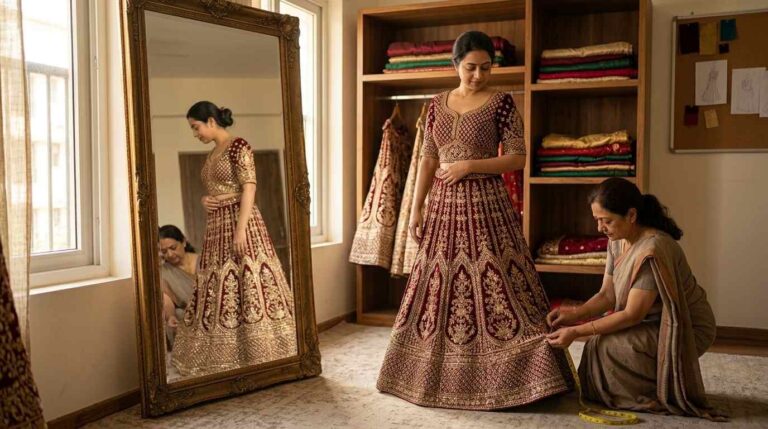
Standing in front of a rack of bridal lehengas, you have probably heard terms like Zardozi, Gota Patti, or Aari work thrown around without much explanation of what they actually mean. Each technique carries its own history, construction method, and price logic, and knowing the difference genuinely changes how confidently you shop.
This guide breaks down the five embroidery techniques you are most likely to encounter in Ahmedabad wedding wear, so you know exactly what you are looking at, and what you are paying for.
Why Knowing Your Embroidery Matters Before You Buy
Embroidery is often the single biggest factor behind a bridal outfit’s price, yet it is the one detail most brides understand the least before they start shopping.
What This Guide Will Help You Do at Your Next Fitting
By the end of this guide, you will be able to recognise each of these five techniques by sight, understand roughly why one costs more than another, and know what to check before committing to a heavily embroidered piece.
1. Zardozi: The Royal Metal-Thread Embroidery
Zardozi is perhaps the most recognisable heavy embroidery technique in Indian bridal wear, and its name alone hints at its regal history.
Origins in the Mughal Courts and What the Name Actually Means
The word Zardozi comes from the Persian words for gold and embroidery, and the technique traces its roots to the royal courts of the Mughal era, where it was used to embellish garments meant specifically for nobility.
How Zardozi Is Made: Gold and Silver Wire, Sequins and Beads
Zardozi uses metallic gold or silver wire, often combined with sequins, beads, and small stones, stitched directly onto fabric to create dense, raised patterns. This combination of materials is exactly what gives Zardozi its characteristic weight and shine.
Our behind-the-scenes look at how we source fabric for high-end embroidery explains how the base fabric itself needs to be chosen carefully to support work this dense.
Zardozi’s Visual Signature: How to Recognise It at a Glance
Zardozi reads as dense, metallic, and dimensional, with raised surface texture you can often see the shadow of, rather than a flat printed or embroidered pattern. Motifs tend to be elaborate, floral, or paisley-based, covering large sections of fabric rather than scattered accents.
How to Judge Zardozi Quality: Weight, Wire Consistency and Backing
Genuine, well-made Zardozi feels substantial without being stiff or uncomfortable, and the metallic wire should sit consistently across the pattern rather than appearing thin or patchy in places. Check the fabric’s backing too, a well-constructed piece will have proper reinforcement to support the embroidery’s weight without pulling or sagging.
2. Gota Patti: Rajasthan’s Lightweight Metallic Applique
Gota Patti offers a very different experience from Zardozi, delivering shimmer and festivity without the heaviness.
Origins in Jaipur and the 3rd-Century Roots of the Craft
Gota Patti originates from Rajasthan, with Jaipur remaining its principal centre of production. Some accounts trace the craft’s roots back as far as the 3rd century, later gaining royal patronage under the Rajputs and Mughal rulers.
How Gota Patti Is Made: Folded Ribbon, Not Stitched Thread
Unlike Zardozi, Gota Patti does not rely on stitched thread patterns. Instead, narrow gold or silver ribbon is cut and folded into shapes, typically floral or geometric, then appliquéd onto the fabric using hemming or back-stitching.
Our guide on chaniya choli customization options covers how Gota Patti is often worked into blouse cuts and skirt borders specifically.
Gota Patti’s Visual Signature: How to Recognise It at a Glance
Gota Patti has a distinctly flat, reflective quality, small folded metallic shapes catching light across the fabric, rather than the raised, textured surface of thread-based embroidery. The overall effect reads as sparkly and festive rather than dense or heavy.
How to Judge Gota Patti Quality: Ribbon Weight, Fold Precision and Secure Stitching
Good Gota Patti uses ribbon with enough weight to hold its folded shape properly, rather than looking flimsy or crushed. Check that each folded piece is stitched securely at its edges, since loose Gota Patti pieces are one of the more common points of wear and tear over time.
3. Resham: Silk Thread Embroidery with a Soft, Colourful Finish
Resham brings a completely different texture and mood to bridal wear, built on the natural softness of silk thread rather than metal.
Origins Along the Silk Road and Its Journey into Indian Bridal Wear
Resham traces its origins to ancient China, where silk thread and silk production techniques were first developed, before travelling along the Silk Road through Persia and eventually becoming firmly established in Indian textile traditions.
How Resham Is Made: Hand-Stitched Floral and Paisley Motifs
Resham embroidery uses dyed silk thread, hand-stitched into floral, paisley, or creeper-like motifs. The thread’s natural sheen gives the finished pattern a soft, luminous quality quite different from the metallic shine of Zardozi or Gota Patti.
If sustainability is a genuine consideration for you, our guide on sustainable bridal choices and ethical embroidery explains how silk sourcing and dyeing practices vary considerably across suppliers.
Resham’s Visual Signature: How to Recognise It at a Glance
Resham reads as colourful and fluid, with smooth, glossy thread work that catches light gently rather than flashing it. Unlike the metallic techniques, Resham motifs often blend closely with the fabric’s own colour palette rather than standing out starkly against it.
How to Judge Resham Quality: Thread Sheen, Stitch Density and Colour Fastness
Genuine, good-quality Resham should have a visible, consistent sheen across the thread work, with stitches placed closely enough together that the pattern reads as solid rather than sparse. It is also worth checking colour fastness, since inferior silk thread can bleed or fade considerably faster than well-sourced material.
4. Aari Work: The Hook-Needle Technique Behind Dense, Detailed Patterns
Aari work brings a distinctive construction method into the mix, built around a specialised needle rather than a standard sewing technique.
Origins in Persian and Mughal Craft Traditions
Aari work developed from Persian embroidery traditions that spread into India during the Mughal period, eventually becoming a distinct regional craft practised by specialised artisans across the country.
How Aari Work Is Made: The Hooked Needle (Ari) and Chain Stitch Method
Aari work takes its name from the hooked needle used to create it. The artisan works from the reverse side of the fabric, pulling thread through in a continuous chain stitch that allows for remarkably fast, dense pattern coverage compared to a standard needle. Our deep dive into Gujarati craftsmanship origins covers a related hand-embroidery tradition rooted much closer to home in Kutch.
Aari Work’s Visual Signature: How to Recognise It at a Glance
Aari work reads as fine, dense, and highly detailed, often incorporating sequins and beads alongside the chain-stitched thread pattern. The motifs tend to be intricate and closely packed, giving the fabric a richly textured, almost tapestry-like appearance.
How to Judge Aari Work Quality: Stitch Uniformity and Pattern Sharpness
Well-executed Aari work shows uniform chain stitches with clean, sharp pattern edges, rather than blurred or uneven motif outlines. Because the technique allows for genuinely dense coverage, sparse or patchy Aari work is usually a sign of rushed or lower-skill execution.
5. Dabka and Zari: Structured Metallic Thread Work
Dabka and Zari round out this list as a related but distinct category of metallic embroidery, often confused with Zardozi but built quite differently.
What Sets Dabka and Zari Apart from Zardozi
While Zardozi typically combines wire, sequins, and beads into elaborate motifs, Dabka and Zari rely more specifically on coiled or twisted metallic thread, giving these techniques a more structured, uniform texture across the embroidered surface.
How Dabka Creates Raised, Textured Surface Detail
Dabka thread is a tightly coiled metallic wire that, when stitched onto fabric, creates a distinctly raised, ridged texture. This coiling is what separates Dabka’s tactile surface from the flatter shine of Gota Patti or the smoother finish of standard Zari thread work.
Dabka and Zari’s Visual Signature: How to Recognise It at a Glance
Dabka reads as ridged and sculptural, with a visibly coiled, almost corded texture running through the pattern. Zari, by contrast, tends to look smoother and more like fine metallic outlining, often used to edge or accent a design rather than fill it entirely.
How to Judge Dabka and Zari Quality: Thread Tension and Surface Uniformity
Good Dabka work holds its coiled shape evenly along the pattern, without flattening or unravelling in places. For Zari, check that the metallic thread lies flat and consistent, since uneven tension is one of the clearest signs of lower-quality construction.
How These Five Techniques Compare Side by Side
Once you understand each technique individually, comparing them side by side makes shopping considerably easier.
Weight and Comfort: Which Techniques Suit a Full Day of Wedding Functions
Zardozi and Dabka carry the most weight of the five, which matters if you are wearing an outfit for many hours. Gota Patti and Resham offer considerably more comfort for extended wear, while Aari work sits somewhere in between, depending on how densely it is worked.
Cost Drivers: Why Some Techniques Cost More Per Square Inch Than Others
Techniques that require more time, more raw material, or greater artisan skill per square inch of fabric naturally cost more. Zardozi and Dabka, with their labour-intensive wirework, typically sit at the higher end, while Gota Patti’s applique method is comparatively quicker to produce at scale.
Which Techniques Are Often Combined on One Bridal Outfit
It is genuinely common to see several of these techniques combined on a single bridal outfit, Zardozi as the main motif work, Dabka for structured borders, and Resham threaded through to soften the overall effect. Our guide on mixing handcrafts like Zardozi, mirror work and Resham embroidery explains how to combine these thoughtfully rather than overwhelming the design.
How to Spot Genuine Handwork vs Machine Embroidery
As demand for these techniques has grown, so has the volume of machine-made imitation work sold under the same names, which makes knowing what to look for genuinely useful.
Checking the Reverse Side of the Fabric
Genuine hand embroidery generally shows a more complex, less uniform pattern on the reverse side of the fabric, since threads are individually worked rather than following a single, repeated machine pass.
Why Slight Irregularity Signals Real Handwork, Not a Flaw
Small variations in stitch spacing, motif symmetry, or thread tension are a natural result of handwork, not a defect. A perfectly uniform, machine-precise pattern is usually a sign of mechanical production rather than genuine craftsmanship.
Machine Embroidery Warning Signs: Uniform Stitches and Loose Threads
Machine embroidery tends to show perfectly even, repetitive stitching with little variation, and often leaves loose thread ends or a flatter overall texture compared to genuine handwork.
Matching Embroidery Technique to Your Wedding Function
Choosing the right technique for the right function makes a real difference to how comfortable and appropriate your outfit feels across a multi-day wedding.
Heavy Zardozi and Dabka for the Main Ceremony and Reception
Save the heaviest, most elaborate techniques, Zardozi and Dabka, for the main ceremony and reception, where formality matters most and you are less likely to be moving around for hours on end.
Our bridal lehenga collection features both techniques worked to order, so you can choose exactly how much weight and detail suits your own ceremony.
Lightweight Gota Patti and Resham for Mehendi and Sangeet
Gota Patti and Resham suit mehendi and sangeet particularly well, since both functions call for movement and comfort alongside festivity. Our guide on chaniya choli embroidery and design trends covers how these lighter techniques translate into Navratri and festive wear too.
Aari Work for Trousseau Sarees and Everyday Festive Wear
Aari work’s fine, detailed finish suits trousseau sarees and everyday festive pieces particularly well, offering richness without the weight of a full bridal ensemble.
Why Custom Orders Give You More Control Over Embroidery Quality
Choosing a custom order gives you a level of control over embroidery that ready-made pieces simply cannot offer.
Choosing Your Technique Before Construction Begins, Not After
A custom order lets you choose your embroidery technique, density, and placement before construction begins, rather than accepting whatever combination a ready-made piece happens to include. Our comparison of designer boutiques versus online ethnic wear explains why this level of control is especially difficult to get right when shopping online.
What to Ask Your Boutique About Embroidery Before You Commit
Ask specifically which technique is being used, whether the work is hand-done or machine-assisted, and how the embroidery affects both weight and care requirements. Our guide on caring for heavy embroidery is worth reading once you have chosen your technique, since proper care varies considerably between metallic and thread-based work.
Bringing These Techniques into Your Wedding Wardrobe in Ahmedabad
Once you understand what makes each technique genuine, the next step is deciding which one suits your own wedding wardrobe best.
Discussing Embroidery Options at Your First Consultation
Bring reference images and be ready to discuss which functions you are shopping for, since this helps your designer recommend the right combination of techniques for weight, budget, and formality.
Our guide on choosing bridal jewellery to complement heavy embroidery is a useful next step once you have settled on a technique.
Booking a Fitting to See These Techniques in Person
At Fashion Autograph, we work directly with genuine Zardozi, Gota Patti, Resham, Aari, and Dabka craftsmanship, and seeing these techniques in person makes the difference between them far easier to appreciate than any photograph can. You can get in touch with our team to book a fitting and explore these techniques for your own wedding wardrobe.
FAQs
What is the difference between Zardozi and Dabka embroidery?
Zardozi combines wire, sequins, and beads into elaborate raised motifs, while Dabka relies specifically on tightly coiled metallic thread, giving it a more structured, ridged texture across the surface.
Which embroidery technique is best for a lightweight mehendi outfit?
Gota Patti and Resham both suit lightweight mehendi outfits well, since neither carries the weight of metal-thread techniques like Zardozi or Dabka.
How can I tell if Zardozi embroidery is handmade or machine-made?
Check the reverse side of the fabric for slight irregularity in the stitching, and look at the wire consistency across the pattern. Genuine handwork shows natural variation, while machine work tends to look perfectly uniform.
Is Gota Patti embroidery comfortable to wear for long wedding functions?
Yes, Gota Patti is known for offering shimmer and festivity without significant weight, making it considerably more comfortable for long functions than heavier metal-thread techniques.
Why does Zardozi cost more than Resham embroidery?
Zardozi requires more raw material, including metallic wire, sequins, and beads, along with more labour-intensive construction, which pushes its cost higher than Resham’s silk thread technique.
Can different embroidery techniques be combined on one outfit?
Yes, combining techniques, such as Zardozi as the main motif with Resham threaded through for softness, is a common and longstanding practice in bridal wear design.
What should I check before buying a heavily embroidered bridal outfit?
Check the fabric’s backing and reinforcement, the consistency of the thread or wire work, and whether the embroidery shows natural handwork irregularity rather than a perfectly uniform machine-made pattern.


