
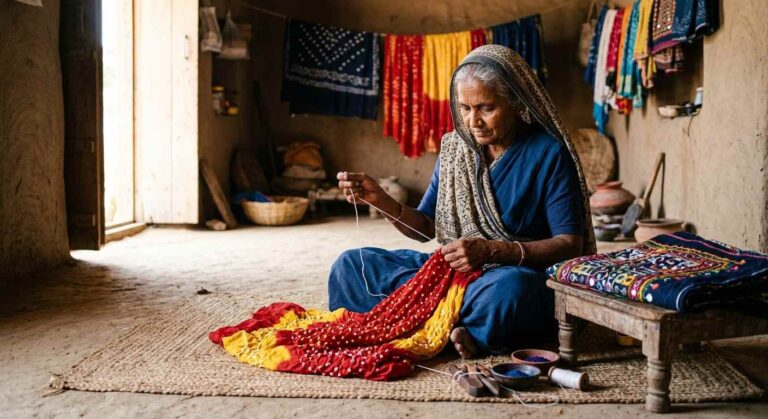
Walk through any wedding season market in Ahmedabad and you will see them everywhere. The tiny, unmistakable dots of Bandhani. The rippling diagonal waves of Leheriya. The sudden flash of light from a piece of mirror work catching the sun.
These three crafts feel so familiar to anyone who has grown up in Gujarat that it is easy to forget how remarkable their history actually is. This guide takes you through where each one genuinely came from, how they are made, and how to recognise the real thing when you see it.
The Living Heritage Behind Gujarat’s Most Recognisable Textiles
Gujarat holds a rare position in Indian textile history, home to not one but several distinct hand-crafted traditions that have survived for centuries and are still practised today.
Why Every Ahmedabad Woman Has Worn This Heritage, Even Without Realising It
If you have ever worn a Bandhani dupatta to a family function or admired a mirror-worked blouse at a wedding, you have already engaged with living history. These are not museum pieces. They are crafts still made by hand, in Gujarat, often by the descendants of the same communities who developed them centuries ago.
Bandhani: Gujarat’s Ancient Art of Tying and Dyeing
Bandhani is arguably the most recognisable Gujarati textile craft in the world, and its story goes back far further than most people realise.
Where the Name Comes From and How Old the Craft Actually Is
The word Bandhani comes from the Sanskrit word for “to tie.” The technique involves tying thousands of tiny knots into fabric before dyeing it, so the tied sections resist the dye and form the pattern once untied.
References to the craft appear in historical texts and in the Ajanta cave paintings, and some accounts trace its roots back thousands of years to the Indus Valley Civilisation.
How the Sindhi Khatri Community Brought Bandhani to Kutch
The Khatri community, credited with much of Bandhani’s ongoing practice in Kutch, is understood to have brought the craft to the region from Sindh. Bandhani tying has traditionally remained a family trade within this community, passed down and practised largely by women working from home.
From Mughal Courts to London: Bandhani’s Historic Journey Beyond Gujarat
Bandhani gained particular favour during the Mughal era, reportedly becoming popular at Emperor Akbar’s court. By the 18th century, Bandhani silk had already travelled as far as London, a genuinely early example of an Indian regional craft reaching international markets.
The 2021 GI Tag: Why Kutch Bandhani Is Now Officially Protected
In 2021, Kutch Bandhani received a Geographical Indication, or GI, tag. This is an official recognition that ties the craft specifically to its region of origin, protecting its name and helping distinguish genuine Kutch-made Bandhani from imitations produced elsewhere.
Jamnagar’s Famous Red: Why Water Chemistry Shaped a Regional Signature
Jamnagar has long been known for producing an especially vivid red Bandhani, a quality often attributed to the specific mineral composition of the local water used in the dyeing process. This is a good example of how geography itself can shape a craft’s regional identity.
Understanding Bandhani Patterns and What They Symbolise
Beyond the tying technique itself, Bandhani carries a rich visual and symbolic language that varies by pattern and colour.
Boond, Ekdali, Mothra & Shikari: Reading the Different Tie Patterns
Different tying methods produce distinct named patterns. Boond refers to a small dot pattern, Ekdali groups small dots into clusters, Mothra creates diamond shapes, and Shikari incorporates motifs of animals and birds. Each pattern reflects a slightly different tying technique passed down through generations of artisans.
What the Colours Mean: Red for Marriage, Yellow for New Beginnings
Colour carries genuine meaning in Bandhani. Red is closely associated with marriage, yellow with new beginnings, and green with prosperity, which is why specific colours appear so consistently at particular life events and festivals across Gujarat.
Why a Genuine Bandhani Saree Can Contain Thousands of Individual Knots
A single, intricately patterned Bandhani saree can involve tens of thousands of individual hand-tied knots. This gives you a genuine sense of the time and skill involved in producing one piece, long before it even reaches the dyeing stage.
Leheriya: The Wave Pattern Born from Rajasthan’s Diagonal Dye Technique
Leheriya is often mentioned alongside Bandhani, and the two crafts share a close, overlapping history across Gujarat and Rajasthan.
What Leheriya Means and How the Diagonal Roll Creates the Wave Effect
Leheriya takes its name from the word for “wave.” The fabric is rolled diagonally and tied before dyeing, which produces the technique’s signature diagonal stripes once unrolled, evoking the movement of flowing water.
Leheriya’s Relationship to Bandhani and Where the Two Techniques Meet in Gujarat
Leheriya and Bandhani are closely related resist-dyeing techniques, and both appear across Gujarat and Rajasthan, often on the same category of garments. Our deep dive into traditional Gujarati saree styles explores how these techniques show up specifically in saree traditions across the state.
Mothda: When Diagonal Waves Become a Criss-Cross Pattern
When the diagonal rolling technique is applied in two directions rather than one, the result is a criss-cross diamond pattern known as Mothda, a variation that sits closely alongside both Leheriya and Bandhani in technique and appearance.
Why Leheriya Is Traditionally Linked to Monsoon and Teej Celebrations
Leheriya, particularly in yellow and red, is traditionally worn during Teej, a monsoon-season festival, with the fabric’s wave-like pattern echoing the season’s association with rain and renewal.
Mirror Work: How Small Pieces of Glass Became a Gujarati Signature
Mirror work, also called Abhla or Shisha embroidery, brings a completely different technique into the Gujarati textile story, one built on embroidery rather than dyeing.
From Mica to Glass: How Abhla Embroidery Actually Began
Mirror work is believed to have developed in the 17th century, when artisans first used small pieces of mica, and later glass, to recreate the light-catching effect of the jewels and precious metals worn by nobility, at a fraction of the cost.
The Protective Symbolism Behind Wearing Mirrors
Beyond decoration, mirrors carried genuine protective symbolism. Traditional belief held that mirrors could ward off evil by reflecting it back, which made mirror work especially significant for brides during the transition of marriage and for children as protection against the evil eye.
Kutch’s Rabari, Ahir and Meghwal Communities: Different Hands, Different Styles
Several communities within Kutch, including the Rabari, Ahir, and Meghwal, developed their own distinctive approaches to mirror work embroidery, each bringing different stitch styles, motifs, and mirror placements to the craft, which is why Kutch mirror work shows such visible regional variety even within one district.
How Kutch Mirror Work Earned Its Own GI Recognition
Like Bandhani, Kutch mirror work has received its own Geographical Indication tag, formally recognising the craft’s specific regional origin and helping protect it against mass-produced imitations sold under the same name.
How These Three Crafts Differ in Technique and Character
Although Bandhani, Leheriya, and mirror work are often mentioned together, they are built on genuinely different processes and produce very different visual effects.
Tie-and-Dye vs Embroidery: Two Fundamentally Different Processes
Bandhani and Leheriya are both resist-dyeing techniques, where fabric is tied before dyeing to create a pattern. Mirror work, by contrast, is an embroidery technique, where thread and small mirrors are stitched directly onto finished fabric. One shapes the fabric’s colour, the other adds texture and dimension on top of it.
Comparing the Visual Signatures: Dots, Waves and Sparkle
Bandhani reads as small, dense dots. Leheriya reads as flowing diagonal stripes. Mirror work reads as scattered or clustered points of light. Once you know what to look for, these three signatures become genuinely easy to tell apart at a glance.
How These Crafts Have Traditionally Been Combined on a Single Garment
Traditionally, these techniques are far from mutually exclusive. A Bandhani saree bordered with mirror work embroidery, or a Leheriya dupatta finished with small mirror accents, is a longstanding combination rather than a modern invention, showing how these crafts have historically complemented rather than competed with each other.
Spotting Authentic Craftsmanship vs Machine Imitation
As demand for these crafts has grown, so has the volume of machine-made imitation work sold under the same names, which makes knowing what to look for genuinely useful.
What Genuine Hand-Tied Bandhani Looks Like on Both Sides of the Fabric
Authentic, hand-tied Bandhani shows its pattern clearly on both sides of the fabric, with slightly uneven dots and a subtly crinkled texture from the knots. Printed imitations, by comparison, typically show a crisp pattern on only one side.
Signs of Real Hand-Stitched Mirror Work vs Glued, Machine-Applied Mirrors
Genuine mirror work uses a stitched lattice to hold each mirror in place without any adhesive, which keeps the mirrors secure through repeated wear and washing.
Machine-applied mirror work, common in budget wholesale garments, often relies on glue instead, and these mirrors can come loose or fall off entirely after just a few washes.
Why Slight Irregularity Is a Mark of Authenticity, Not a Flaw
Small variations in dot spacing, knot size, or mirror placement are a natural result of hand craftsmanship, not a defect. A perfectly uniform, machine-precise pattern is usually a sign of mechanical production rather than genuine handwork.
These Crafts in Modern Ahmedabad Wardrobes Today
Far from being confined to traditional sarees, these crafts have found their way into a wide range of contemporary garments worn across Ahmedabad today.
Bandhani and Mirror Work Beyond the Traditional Saree: Kurtis, Lehengas and Blouses
Bandhani prints and mirror work embellishment now appear regularly on kurtis, lehengas, and designer blouses, giving these heritage techniques a place in everyday and festive wardrobes well beyond the traditional saree.
Our guide on mixing handcrafts like zardosi, mirror work and resham embroidery explains how these techniques can be combined thoughtfully on a single garment.
Why These Techniques Remain a Navratri and Wedding Season Staple
Bandhani and mirror work in particular remain closely associated with Navratri and wedding season dressing, since both crafts carry the festive colour and celebratory symbolism these occasions call for.
How Contemporary Designers Are Reworking Heritage Craft for 2026 Silhouettes
Contemporary Indo-Western and fusion silhouettes increasingly incorporate these traditional techniques in updated ways, proving that heritage craft and modern design are not opposing forces.
Our guide on wearing Indo-Western without looking costume-like is worth reading if you want to bring a heritage craft like mirror work into a more contemporary silhouette without it feeling mismatched.
Why Choosing Custom-Made Pieces Supports These Living Crafts
Choosing genuinely handcrafted pieces does more than guarantee quality, it directly supports the artisan communities who keep these traditions alive.
How Custom Orders Connect You Directly to Artisan-Led Work
A custom order gives you far more visibility into exactly who made your garment and how, compared to buying an unlabelled piece off a shelf, which often means the work genuinely comes from artisans practising these techniques rather than a factory imitation.
What to Ask For When You Want Genuine Bandhani, Leheriya or Mirror Work
Ask specifically whether the piece is hand-tied or hand-embroidered, rather than printed or machine-applied, and ask to see the reverse side of the fabric where relevant, since this is often the clearest way to confirm genuine craftsmanship before you commit to an order.
Bringing Heritage Craftsmanship into Your Wardrobe in Ahmedabad
Once you understand what makes these crafts genuine, the next step is finding the right piece and the right occasion for them.
Choosing the Right Piece for Your Occasion
A Bandhani dupatta might suit a festive family gathering, while a heavily mirror-worked blouse could be the standout piece for a wedding function. Our guide on designer blouses engineered for heavy embellishment is useful if you are planning to pair a mirror-worked piece with statement jewellery.
Booking a Consultation to Explore These Techniques
At Fashion Autograph, we work directly with genuine Bandhani, Leheriya, and mirror work craftsmanship, and a proper consultation lets you see and feel the difference between authentic handwork and machine imitation for yourself. You can get in touch with our team to explore these techniques for your next occasion.
FAQs
What is the difference between Bandhani and Leheriya?
Bandhani creates small, dense dot patterns through individual tied knots, while Leheriya creates flowing diagonal stripes by rolling and tying the fabric diagonally before dyeing.
How can I tell if Bandhani fabric is handmade or printed?
Genuine hand-tied Bandhani shows its pattern on both sides of the fabric with slightly uneven dots and a subtle texture, while printed imitations typically show a crisp pattern on only one side.
Why does Kutch Bandhani have a GI tag?
Kutch Bandhani received its Geographical Indication tag in 2021, officially recognising the craft’s specific regional origin and helping protect it from imitations produced elsewhere.
What does mirror work symbolise in Gujarati clothing?
Mirror work traditionally carries protective symbolism, with mirrors believed to ward off evil by reflecting it back, making it especially significant for bridal wear and children’s clothing.
Which Gujarati craft is best suited to Navratri outfits?
Both Bandhani and mirror work are closely associated with Navratri, since their festive colours and celebratory symbolism suit the occasion particularly well.
Are Bandhani and mirror work often combined on the same garment?
Yes, combining Bandhani fabric with mirror work embellishment, particularly along borders, is a longstanding traditional pairing rather than a recent trend.
What should I look for when buying authentic mirror work embroidery?
Look for mirrors held in place with stitched thread rather than glue, since genuine hand-stitched mirror work stays secure through repeated wear and washing, unlike machine-applied, glued alternatives.


