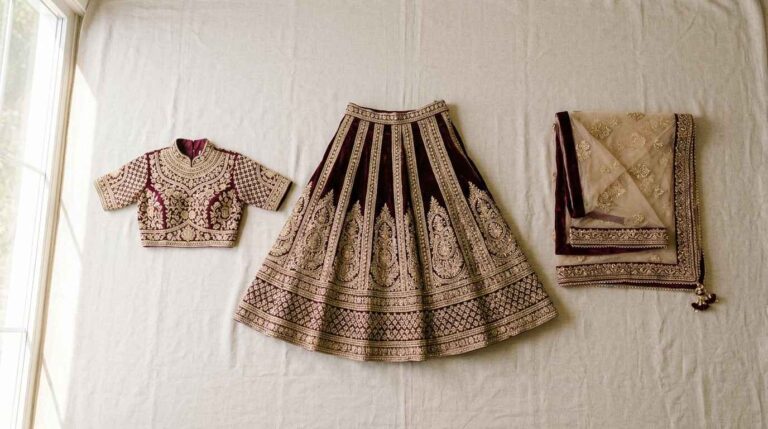
Yes, you can wear your wedding lehenga again, and in most cases you don’t need to cut it to do so. The real question is how far to go. You can re-wear the whole set with changed styling, restyle it by recombining its pieces, or remake it by cutting and re-stitching. The right route depends less on taste than on the garment: its colour, how the embroidery is spread, how the skirt is built, and whether the blouse still fits.
This guide helps you assess your lehenga first. It then shows what each route involves, what can go wrong, and when to leave the outfit alone.
The three routes at a glance
| Route | What you do | Reversible? | Best when |
|---|---|---|---|
| Re-wear | Wear the full set with different styling | Fully | It still fits and an occasion suits it |
| Restyle | Split the set and pair pieces with other clothes, or add a new blouse or dupatta | Fully | You want variety and want the original left intact |
| Remake | Cut and re-stitch: reduce volume, shorten, convert to an anarkali or gown, rework the dupatta | Mostly not | It is too heavy or too bridal as it stands, and you are ready to commit |
Terms used below. The choli is the blouse. The can-can is the underskirt that gives volume. A kali is one panel of the skirt. Zardozi is heavy metallic-thread embroidery; our bridal embroidery guide explains the other techniques.
Check your lehenga before you choose
Spend ten minutes on these five checks. They decide how much freedom you really have.
- Colour. Bright bridal red tends to read as “the bride” wherever you wear it. Ivory, champagne, wine, deep green and softer shades read as festive, so they travel to more occasions. Red isn’t ruled out, but it narrows your options. Our guide to bridal lehenga colour explains what each shade signals.
- Embroidery density and placement. Dense work across the whole skirt is usually the hardest to alter, because most cuts cross embroidery and every raw end has to be secured. Work concentrated on the blouse, border and dupatta leaves the skirt much freer. See heavy vs light embroidery.
- Skirt construction. Check the number of panels, whether the can-can is separate or stitched in, the lining, where the border ends at the hem, and the weight. These decide which remakes are straightforward. Fabric matters too: see silk vs organza.
- Blouse fit. The blouse is cut closest to your body, so it often stops fitting first. How much it can change depends on seam allowance and on whether embroidery runs up to the seams. Our blouse masterclass covers how blouses are built.
- Dupatta. It is often the most reusable piece. Note its weight, whether it has borders on all sides, and whether you wore a double drape.
Where to start, by lehenga type
| If your lehenga is… | Start with | Why |
|---|---|---|
| Bright red with dense, all-over zardozi | Restyle the blouse and dupatta; re-wear the full set only at close family events | Dense work makes cutting risky, and the colour limits occasions |
| A softer, non-bridal colour with work concentrated on the blouse, border and dupatta | Any route, including an anarkali or gown | Fewer embroidery cuts, and the colour works widely |
| Lovely but too heavy or too full | Reduce the can-can or panels | Most discomfort sits there |
| Fine, but the blouse no longer fits | Resize or remake the blouse | The skirt and dupatta may need nothing |
| Deeply sentimental | Restyle only, then store it well | Nothing is cut, so nothing is lost |
| Something you won’t wear again | Pass it on or keep it | See the section near the end |
Do this before anyone cuts anything
- Have it cleaned by someone experienced with embroidered bridal wear.
- Photograph all three pieces, laid flat and worn.
- Run the five checks above.
- Pick a real occasion and a route. Remaking with no occasion in mind is how good lehengas get cut for nothing.
- Consult a maker experienced in bridal alteration, and ask for the offcuts back.
- Allow time for at least one fitting.
Re-wear it as it is, without repeating your bridal look
Wearing the full set again is a styling job, not a tailoring one. A few changes alter the impression more than you’d expect:
- Jewellery. The full bridal set announces “bride.” One statement piece usually reads as a guest. Our guide to bridal jewellery for heavy embroidery helps you pick.
- The dupatta. Drape it differently, or use one drape where you wore two.
- Hair and make-up. Keep them softer than on the wedding day.
- Footwear and hem. Your hem was cut for the heels you wore at the wedding (we advise wearing your wedding heels at length measurement). In flats it will drag, so wear similar heels or have the hem adjusted.
Can you wear it to another wedding?
Advice online contradicts itself. Some sources say never; others call it the ideal occasion. In practice it comes down to your family and to colour. Outfits at a wedding are often planned around the bride’s palette, so avoid her colours, and avoid red if she is wearing red. If you are unsure, ask her or the elders. A changed blouse or dupatta and lighter jewellery usually help.
Restyle: new combinations, no cutting
The simplest rule is one statement piece per outfit. A heavily embroidered skirt needs a quiet top. A heavily embroidered blouse needs a plain skirt or saree.
| Piece | Pair it with | Good for, and watch for |
|---|---|---|
| Skirt | A plain or softly textured blouse in a deliberate contrast, or a fitted top with a jacket | Dinners, sangeet, festive evenings. A new top must sit well at the waistband |
| Blouse | A plain silk or georgette saree, a plain raw silk or brocade skirt, or high-waisted trousers | Pujas, Diwali visits. A heavy blouse with a heavy saree competes |
| Dupatta | A plain anarkali, salwar kameez or saree, or worn as a stole | Winter functions, family weddings. Pin it securely |
A new blouse for the old skirt is the single most effective restyle. The common trap is near-matching: choose a clear contrast, or a clear match, rather than almost the same colour. Our Indo-Western styling guide covers how to keep mixed looks from feeling like costume.
Remake: what a tailor actually changes
Remaking means cutting and re-stitching, and most changes are permanent, so choose them deliberately.
| Change | What it involves, and when it suits | Watch for |
|---|---|---|
| Reduce the can-can | Replace or lighten the underskirt that gives volume. Suits a skirt that is hot, heavy or too full | Stitched-in layers mean more work |
| Remove panels (kalis) | Take out some panels and re-join. Suits a very full skirt | Embroidery and border continuity can break at the join |
| Shorten | Raise the hem for flats or a midi length | The border may be removed or re-laid |
| Resize or reshape the blouse | Let out, take in or re-fit. See our designer blouse page | Limited by seam allowance and embroidery near the seams |
| Anarkali | Join a long bodice to the skirt at the waist. Suits a skirt that is the star, in a non-bridal colour | How the waistband embroidery and gathers are handled |
| Gown | A new structured bodice joined to the skirt. Suits a reception-style look | May need matching fabric and a seam that carries the weight |
| Dupatta to jacket or cape | Cut and re-stitch the dupatta. Suits winter or wedding-guest dressing | Borders may be lost, and it can’t be undone |
The waistline usually decides what is possible
A lehenga skirt is gathered or pleated into a waistband. Most conversions, whether anarkali, gown or even a shorter skirt, have to deal with that point. Embroidery at or near the waist can be hidden, interrupted or cut, and the skirt’s weight then pulls on a new seam. Constructions vary, so ask any maker how they would handle the waist on your lehenga. A specific answer is a good sign.
Smaller second lives
If you’d rather not cut the main outfit, offcuts, borders and the dupatta can become something smaller. Examples are an embroidered potli or belt, a framed section of embroidery, or a child’s ceremony outfit.
The dupatta can also be joined to plain fabric to make a half-and-half saree. These all depend on the embroidery being intact where you cut.
When to leave it alone
- Dyeing. Fabric, thread, sequins and metal zari take dye differently, so results can be uneven. Treat it as high risk, and only with a specialist who tests first.
- Remaking out of guilt, not for an occasion. If nothing on your calendar needs it, keep it intact for now.
- Any tailor. Bridal embroidery is delicate and cuts are permanent. Choose someone experienced with embellished wear.
- Cutting before cleaning and checking. See the sequence above.
Which route for which occasion
Customs differ across families and communities, so treat these as starting points and check with your elders.
| Occasion | Suggested route | What to change |
|---|---|---|
| Sibling’s or cousin’s wedding | Re-wear or restyle | Blouse, dupatta, jewellery; avoid the bride’s colours; check hem and blouse comfort for a long day |
| Sangeet, reception, engagement | Restyle or remake (anarkali, gown) | Reduce volume if you’ll dance. See our Indo-Western gowns |
| First Diwali, Bestu Varas, family visits | Restyle | Dupatta over a simple anarkali, or the blouse with a saree. See our Diwali outfit guide |
| Navratri and garba | Usually not the bridal skirt | A dense zardozi skirt is rarely built for hours of twirling; use the dupatta or blouse, or a lighter chaniya choli |
| First Karva Chauth, if your family observes it | Your choice | Some new brides wear the wedding outfit, others choose something new; family tradition decides |
| Baby ceremony, puja, family lunch | Restyle | Dupatta or blouse only; the full skirt is usually too grand |
Ahmedabad’s heat matters too. Lining, weight and volume all affect comfort; our guide to fabrics for Ahmedabad’s weather explains the trade-offs.
Choosing who does the work
If your lehenga came from a boutique, start by asking them, because they know how it was built. Whoever you choose, ask:
- Have you altered embellished bridal wear before, and can I see examples?
- How will you handle the waistline embroidery on my lehenga?
- Will I get the offcuts back?
- How many fittings are included?
- Can I have an itemised quote and a date for each stage in writing?
- What happens if the result isn’t what we agreed?
Our post on what to ask your bridal boutique covers similar ground for new orders, and our fitting checklist shows what to bring to appointments. For fit, see how to ensure a perfect fit.
Bring or send: all three pieces, photos of the lehenga worn at your wedding, the heels you’ll wear, the date of the occasion, and reference photos of the look you want. If you live abroad, our NRI ordering guide explains how remote measuring and delivery work for new orders; ask any maker whether a remake can be assessed from photos.
What it costs and how long it takes
There is no standard price, because scope varies too much. These factors move a quote:
- How much is cut and re-stitched
- Embroidery density and the handwork involved
- Whether matching or new fabric is needed
- Lining and structure
- The number of fittings
- How tight the deadline is
Ask for an itemised quote, and allow weeks, not days, before the occasion.
A simple cost-per-wear check
Cost per wear = (purchase price + any remake cost) ÷ number of wears.
Take a hypothetical lehenga bought for ₹90,000:
| Total wears | Cost per wear (before any remake) |
|---|---|
| 1 | ₹90,000 |
| 3 | ₹30,000 |
| 6 | ₹15,000 |
To include a remake, add your quote to the ₹90,000 and divide again. What moves the figure most is the number of wears, not the size of the quote. If you would realistically wear the outfit only once more, a remake may not pay off, and keeping it intact is a perfectly good decision.
If you won’t wear it again
You can pass it to a sister or cousin (with the blouse adjusted for fit), donate it, rent or sell it, or keep it. Brides Today notes that many brides are open to pre-loved wedding wear, and that several platforms resell it. Resale depends on the maker and condition, so don’t count on a fixed percentage.
Storing it
Storage advice online contradicts itself, so it helps to follow conservation guidance. The Canadian Conservation Institute notes that some textiles shouldn’t be rolled, including those with stiff surface decoration that could split when flexed, and layered pieces that don’t move together. Heavily worked zardozi may fall into that category; for an heirloom, ask a textile conservator.
A museum storage manual advises storing textiles flat in boxes where possible, with acid-free tissue supporting any folds, and a university conservation guide recommends interleaving layers with tissue where metallic thread is present. Textiles should also be clean when stored.
If you are still choosing your lehenga
You can plan the second life now. Gulf News reports brides thinking harder about what happens to an outfit after the wedding, with modular two-piece outfits offering restyling options. Practical steps:
- Choose a colour you would wear to other occasions.
- Ask for embroidery concentrated on the blouse, border and dupatta rather than all over the skirt.
- Ask whether the can-can can be separate.
- Ask for generous seam allowance on the blouse for later changes.
Our bridal lehenga buying guide covers budget, fabric and fit, custom vs designer RTW explains the two routes, and you can see our bridal lehenga collection.
Not sure which route is right?
If you’d like a second opinion on your lehenga, Fashion Autograph offers private consultations with designer Naimisha Munshi, and the boutique’s in-house team handles stitching, handwork and alteration. Book a consultation and browse our work gallery for examples.
Frequently asked questions
How soon after the wedding should I decide?
There is no deadline. Have it cleaned and inspected, then decide around a real occasion. Avoid cutting in a hurry.
Can the blouse be altered after weight change or pregnancy?
Often, within the limits of the seam allowance. If there isn’t enough, a new blouse is the usual answer.
Is remaking worth it compared with buying new?
It depends on the quote, the number of times you’ll wear it, and how much you value the original. Compare your itemised quote with the cost-per-wear table above.