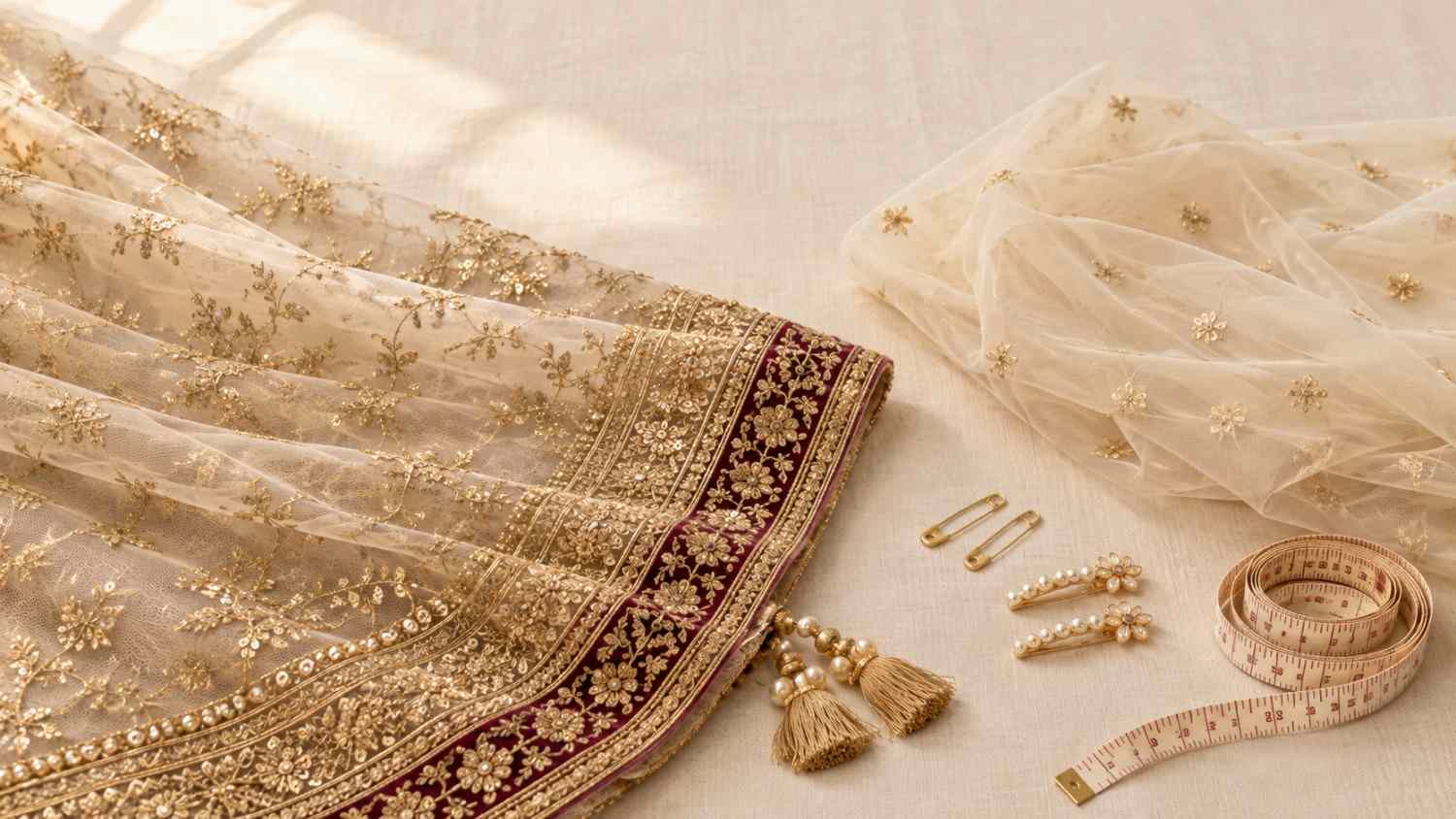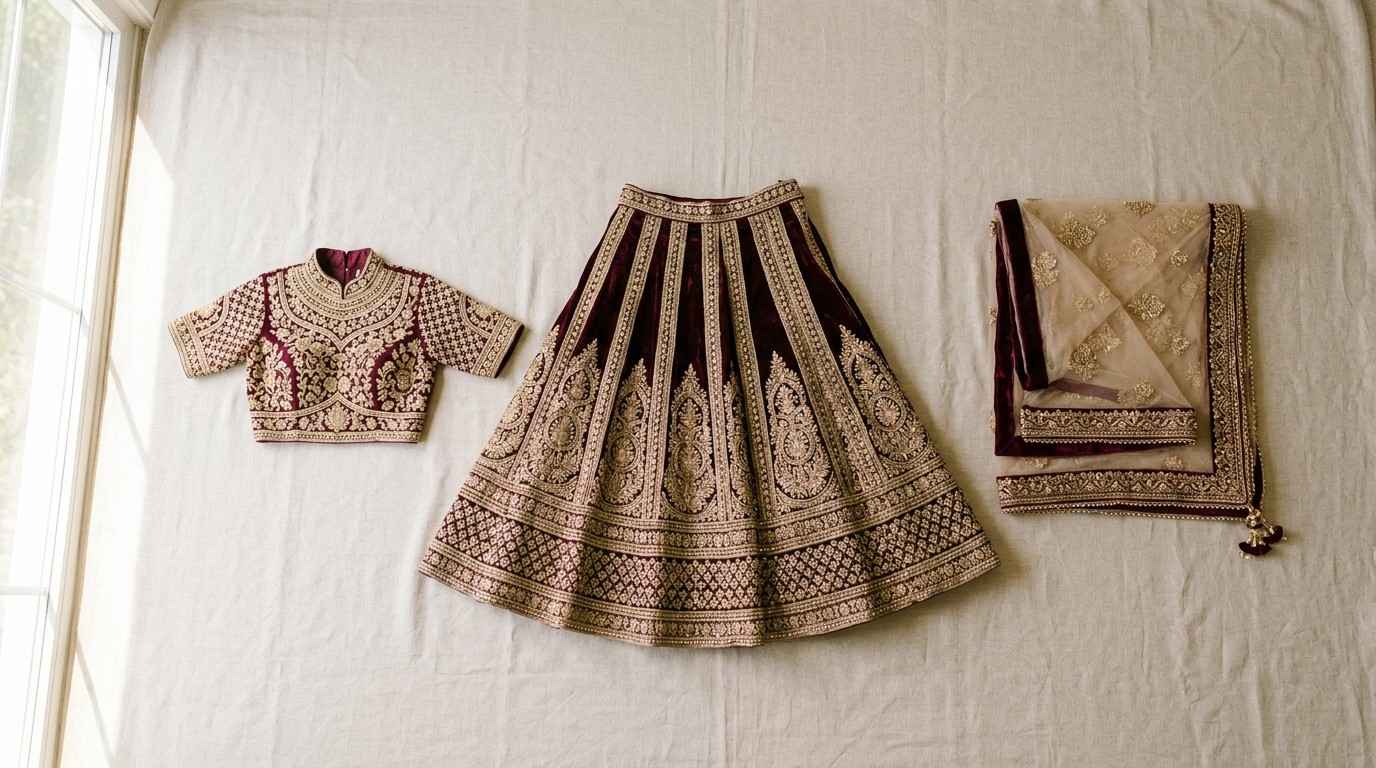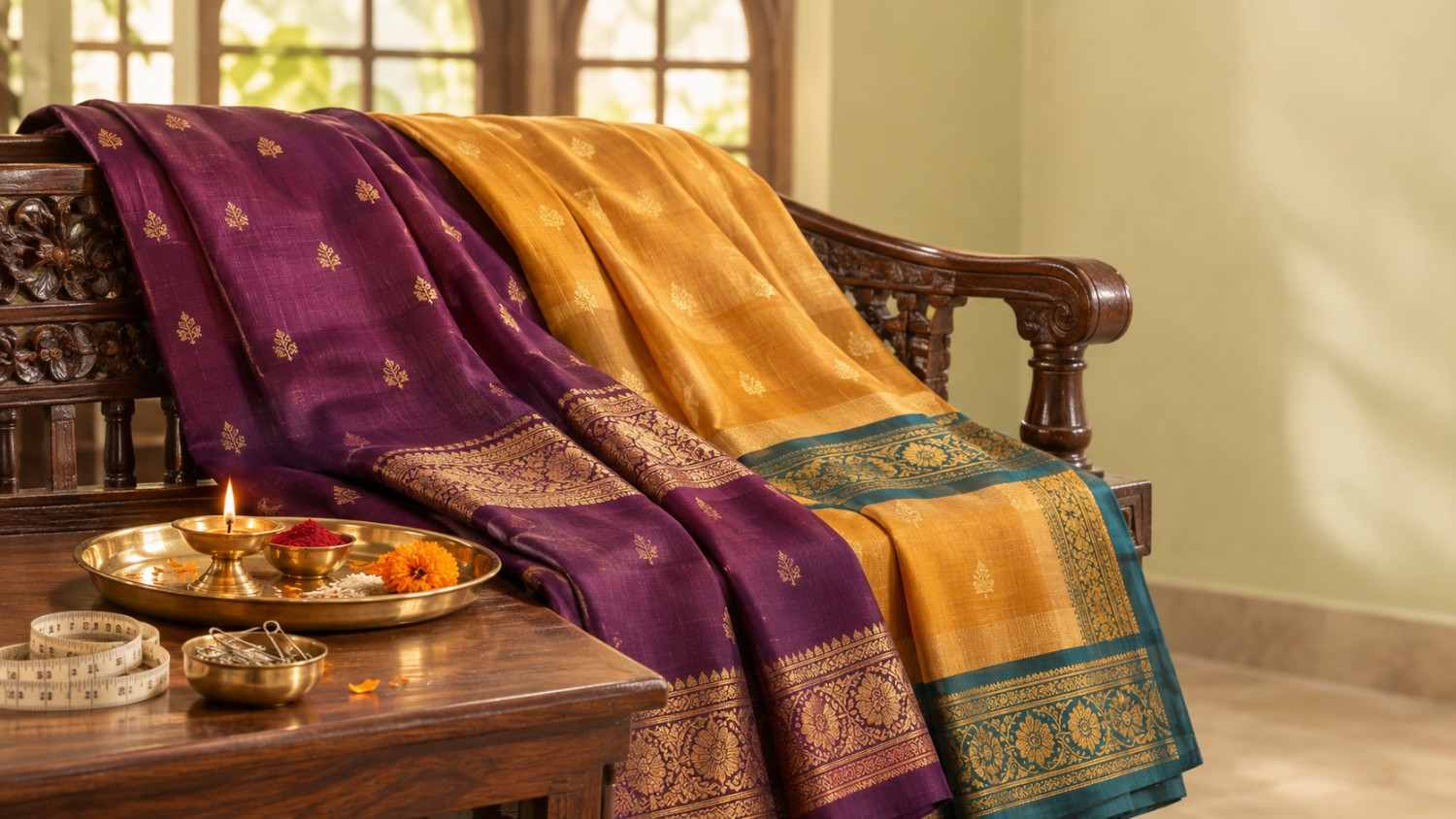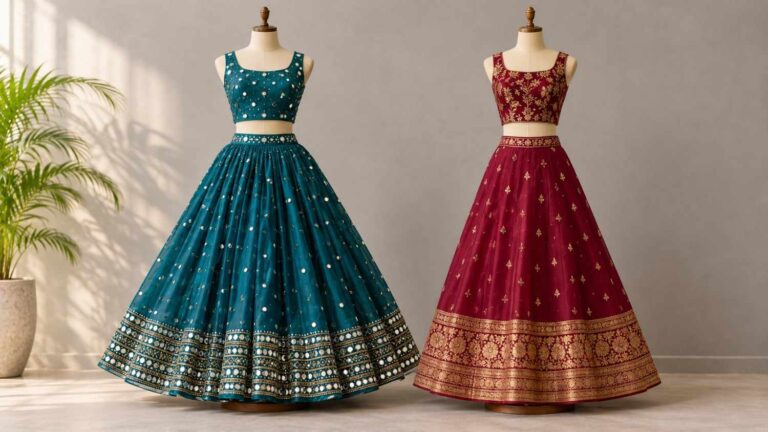
lehenga, ghagra and chaniya choli are one garment family: a long flared skirt worn with a fitted choli (blouse) and a dupatta. The words differ by region and register. Lehenga is the word designers and boutiques use most. Ghagra is an older word for the skirt, and it also names a sari petticoat. Chaniya is the Gujarati word, and the form most people picture at Garba.
The names point to region and occasion. They don’t tell you how an outfit is cut. What decides whether you can dance in it, or sit through a ceremony in it, is the build: flare, weight, waist, blouse and odhani (the Gujarati word for the dupatta). So when you shop or order, describe the build instead of relying on the label.
This page explains the vocabulary and the build. If you are planning a Navratri outfit and want timing, budgets and shopping advice, our Navratri chaniya choli planning guide covers that in detail.
What each word means
| Word | What it names | Where you’ll hear it |
|---|---|---|
| Lehenga | The skirt. “Lehenga choli” is the full set. | Across India. The standard word in boutiques and bridal wear. |
| Ghagra (also gagra) | The skirt, in an older and more regional vocabulary. | North and western India, including Rajasthan and Gujarat. Also the word for a sari petticoat. |
| Chaniya (also chaniyo) | The Gujarati word for the skirt. “Chaniya choli” is the set. | Gujarat, and wherever Gujaratis celebrate Navratri. |
Wikipedia’s lehenga entry lists ghagra, chaniyo, paro, paavada and lacha as other names for the same skirt. It also points out that “ghagra” refers to the half-slip worn under a sari. Its ghagra choli entry explains that this second meaning is one reason designers and boutiques now prefer “lehenga choli”. So if someone says “ghagra” and means the petticoat, they are not talking about a festive outfit at all.
Why guides contradict each other
Search this topic and you will find pages saying the garments are identical and pages saying they are completely different. Both can be partly right, because they describe the family at different levels. Here is how the most common claims hold up.
| Claim you’ll see | Verdict | Why |
|---|---|---|
| “They are completely different garments.” | Overstated | They belong to one family. Differences come from region, occasion and how a particular piece is made. |
| “A lehenga has a short choli, a ghagra has a long top.” | A tendency, not a definition | Wikipedia describes the choli as usually cropped, and notes that in Punjab the lehenga is traditionally worn with a kurti. The top varies by region and style, not by name. |
| “A chaniya is loose and straight, a lehenga is fitted.” | Contested | A Gujarat scholar describing Garba attire (quoted below) mentions a waistband with many gathers, which gives fullness. The lehenga category itself covers many silhouettes. |
| “Ghagras have drawstrings, lehengas have waistbands.” | A convention | Wikipedia notes that the historic ghagri was tied with a drawstring, yet the same scholar describes a waistband on the Garba chaniya. Construction varies, not the name. |
| “Chaniya choli is only for Navratri.” | A strong association, not a rule | See the Gujarat section below. |
| “Lehenga means Mughal royalty, ghagra means folk dress.” | Only half true | Wikipedia places the lehenga’s rise in popularity in the 16th century in North India, but traces the wider family back to the ancient antariya, uttariya and stanapatta. The ornate lehenga is better understood as a later flowering of an old garment family than as a separate invention. |
There is one sourced difference worth knowing. “Lehenga” is the broader category. Wikipedia’s lehenga entry lists A-line, flared (circular), double-flared, panelled, mermaid and trail styles.
A gathered, full-skirted Garba chaniya is one silhouette within that range, not a rival garment. Even boutiques that specialise in chaniya choli make several shapes. Our own chaniya choli designs include flared, A-line and circular skirts.
What “chaniya” means in Gujarat
Most guides treat the chaniya choli as one standard outfit. An interview in Selvedge magazine with Dr Utpala Desai, a scholar of Gujarat’s folk traditions who co-wrote the dossier that put Garba on UNESCO’s intangible heritage list, describes something more varied.
- The Garba outfit. Women wear a chaniya (long skirt), a fitted and embroidered choli that may be backless (called kaapda), and an odhna of roughly 2.5 metres, traditionally placed over the forehead. The skirt has a waistband and many gathers at the waist.
- Everyday dress first. The chaniya, choli and odhna were traditionally the daily attire of rural Gujarati women. Urban women wear them mainly for Garba.
- Not one style. Embroidery, style and flare differ by community. Thakor women wear voluminous skirts made from 12 to 15 metres of cloth. Koli skirts are embroidered without mirrors, and without embroidery on the back panel where the wearer sits. In today’s urban shops these community markers no longer signal where a wearer is from.
- Garba beyond Navratri. The dance is also performed at family occasions such as weddings and baby showers. It is traditionally danced barefoot.
So “chaniya” names a range of regional skirts, not a single product. That is why asking for the build works better than asking for the word. Many of the craft details behind these skirts, from mirror work to bandhani, are explored in our guide to Gujarati craftsmanship.
Six details that change the outfit
Two pieces sold under the same label can differ on every one of these.
| Detail | What varies | Why it matters | What to ask |
|---|---|---|---|
| Silhouette and flare | A-line, circular, double-flared, panelled, mermaid, trail | Room to spin versus shape | How wide is the hem circle? Is there a can-can layer? |
| Weight and fabric | Light cotton to heavy silk and brocade | Fatigue over hours | Can I hold the skirt and feel its weight? |
| Waist | Gathers, waistband, drawstring, hooks | Comfort and adjustability | How does it close? Can it be adjusted if my size changes? |
| Blouse | Back style, armholes, sleeves, support | Arm movement and security | Can I raise my arms and sit comfortably in it? |
| Odhani | Length, weight, how it is held | Snagging and tangling | How will it be secured while I dance? |
| Surface work and lining | Mirror work, zari, gota; soft lining or none | Snagging, scratching and weight | Is there lining behind any work that touches my skin? |
Fabric is the detail people underestimate. The Gujarat State Handloom & Handicrafts Development Corporation’s Navratri fashion guide recommends lightweight cotton and soft, movement-friendly fabrics for a night of Garba, because comfort matters over several hours of dancing.
Our guide to the best fabrics for designer chaniya cholis goes further. If you are weighing richer materials, silk versus organza explains how fabric changes structure and drape.
Surface work adds weight and snagging risk, so see heavy versus light embroidery before choosing. The blouse is the other detail that decides comfort. Fit matters more than most people expect, and our designer blouse masterclass explains what to look for.
Which should you choose?
Pick the build first, then use whichever name the seller uses. The “likely label” column is a rough guide, not a rule.
| Occasion | Prioritise | Likely label |
|---|---|---|
| Garba or Dandiya | Flare, low weight, a secure blouse, a manageable odhani | Chaniya choli |
| Garba night at a wedding | Dance comfort with a richer finish | A lighter lehenga or a refined chaniya |
| Mehendi or haldi | Easy movement and comfort | A lighter lehenga or chaniya |
| Wedding ceremony | Comfort across long hours, an occasion-appropriate finish | Lehenga |
| Reception | Structure and presence | Formal lehenga |
| Diwali or family function | Comfort for sitting, standing and travelling | A lighter lehenga or chaniya |
Edge cases
- A lehenga for Garba. It works if the build suits dancing: lighter weight, enough flare and a secure blouse. A heavy bridal piece is usually the wrong choice for hours of Garba.
- A chaniya choli at a wedding. It is a normal choice for pre-wedding functions, and Garba is danced at weddings. For the main ceremony or reception, a more formal fabric and finish tends to suit better.
- A bride at her own sangeet. Choose by the six details above, not by the label.
- Barefoot or in footwear. Garba is traditionally danced barefoot. Tell your tailor which you plan to do, because it changes where the hem should sit.
For wedding outfits, start with our bridal lehenga designs. The bridal lehenga buying guide covers the wider decisions behind a wedding outfit.
How to ask for what you want
Skip the vocabulary debate and describe what you need.
At a boutique or with a tailor
- State the occasion and how many hours you will dance or stand.
- Say whether you want a wide, spinning flare or a more structured shape.
- Ask about the skirt’s weight and lining.
- Ask how the waist closes and whether it can be adjusted.
- Describe the blouse movement you need, and test it by raising your arms.
- Decide how the odhani will be worn and secured.
- Say whether you will dance barefoot or in footwear, and bring them to the final fitting.
When reading an online listing
Because the words overlap, a title alone is a weak guide. Look for fabric, lining and flare details in the description. Check the return and alteration terms before ordering for a fixed date.
If you are ordering made to measure, our guide to what to ask your bridal boutique before booking covers policies and fittings. Custom versus designer ready-to-wear explains the trade-offs between the two routes.
Planning an outfit?
Fashion Autograph is a bespoke women’s boutique in Manekbaug, Ahmedabad, where outfits are designed in-house by Naimisha Munshi and made to measure.
If you are planning a Garba outfit or a wedding function, bring the occasion, the hours you will be on your feet and the build you want, and we can talk it through. You can browse our chaniya choli collection or book a consultation.
FAQs
What is the difference between a lehenga and a lehenga choli?
“Lehenga” is the skirt. “Lehenga choli” is the set, with a blouse and usually a dupatta.
Is a chaniya choli only for Navratri?
No. It is strongly tied to Garba, but it was traditionally everyday dress in rural Gujarat, and Garba itself is danced at weddings and other family occasions.
Do all chaniyas look the same?
No. Flare, embroidery and the amount of cloth vary by community, so the word covers a family of skirts.