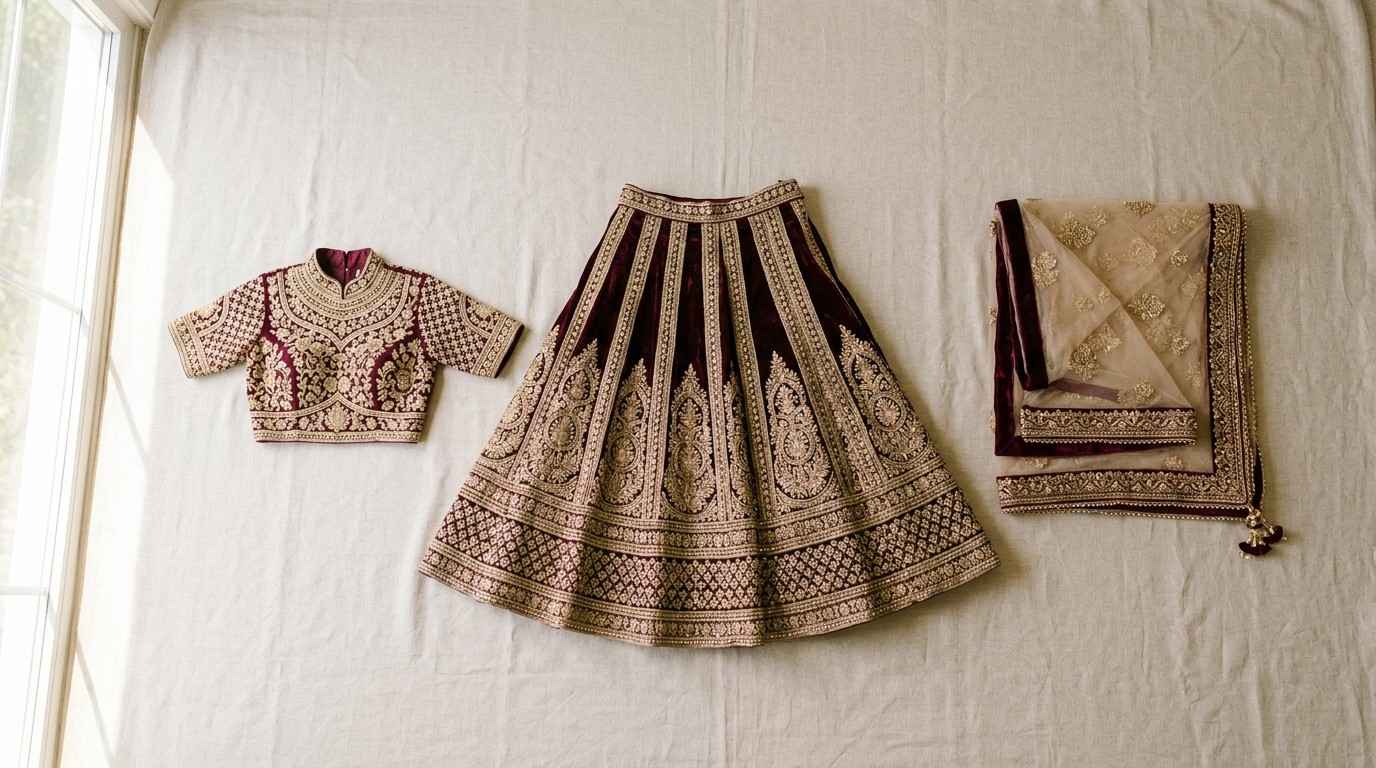
Plan one rich, comfortable outfit for the wedding day and lighter ones for the other functions. Choose a colour that sits beside the bride’s palette, not against it. At a Gujarati wedding that means staying clear of bridal red and of the white-and-red Panetar. Tell the other mother which colour family you have chosen, so you don’t land on the same one.
Your role changes the details. The bride’s mother is usually at the entrance with an aarti thali when the groom arrives, so her outfit has to work standing, with her arms raised and her hands full.
The groom’s mother is more often receiving and hosting her own family’s customs, and in many families she welcomes the bride into her new home. This guide maps those moments to outfits, colours, comfort and timing for both mothers.
A note on customs. Gujarati wedding customs vary by community and by family. Treat this as a planning framework, then confirm the details with an elder in your own family.
Who does what: the role map for both mothers
Most mother-of-the-bride advice assumes one outfit for one event. A Gujarati wedding runs across several days, and the two mothers have different duties at different moments. Knowing those moments shows you where an outfit has to work hardest.

| Function | Bride’s mother | Groom’s mother | What it means for your outfit |
|---|---|---|---|
| Engagement (Gol Dhana or Chandlo Matli) | One family hosts and the other visits with gifts. Which way round depends on the custom and the family. | Same | Polished, but lighter than the wedding. |
| Mandap Muhurat and Grah Shanti (pujas at each home) | At her own home | At her own home | Plenty of sitting and moving about. Choose something simple and secure. |
| Pithi (the Gujarati haldi, held at each home) | Hosts | Hosts | Turmeric stains. Wear something you won’t mind marking. |
| Mameru / Mosalu (gifts from the maternal uncle) | Receives her own brother’s family, who bring gifts for the bride | Many families hold one on the groom’s side too. If yours does, you receive your own brother’s family. | You are hosting a gift-giving. A rich silk or suit suits it better than a casual outfit. |
| Garba night | Many mothers join in, some prefer to watch | Same | Choose something you can move in. |
| Varghodo and Ponkhvu (groom’s procession; welcome at the entrance) | At the entrance with a thali, performing the aarti, blessing the groom and offering sweets | With the groom’s family. The exact role varies. | Standing, hands busy, arms raised. The pallu or dupatta must stay put. |
| Wedding ceremony | Seated for long stretches, often photographed | Same | The hero outfit. It must work sitting and in photographs. |
| Vidaai (the bride’s farewell) | An emotional moment | Not central | Nothing that needs adjusting. Keep the drape secure. |
| Gruhapravesh (the bride enters her new home) | Not usually part of it | In many families she welcomes the bride with an aarti | A second dignified outfit, easy to move in. |
| Reception | Greets guests, stands for photographs | Same | An evening outfit that survives hours of standing. |
This map reflects commonly described practice. Which family hosts which function, and who performs which ritual, differs between families. For the entrance welcome, WeddingWire.in describes the bride’s mother performing the aarti, feeding the groom sweets and blessing him before he enters the mandap, which is why WeddingWire’s Gujarati wedding guide is a useful second reference.
Two things follow from the table.
- The wedding day is the outfit that matters most. It is the longest, the most photographed and the most ritual-heavy.
- You rarely need a separate showstopper for every function. Some days call for a statement outfit and others for a quiet one.
Three conversations before you buy anything
Most outfit mistakes are coordination mistakes. These conversations prevent most of them.
- Ask the bride and groom for outfit photos, not just colour names. “Red” can mean wine or vermilion. Ask which functions have a colour theme.
- Call the other mother. Agree on colour families, not outfits. Also compare how formal each of you plans to be, so one of you isn’t in heavy silk beside the other in light georgette.
- Ask an elder in your own family. Ask which functions your family observes, what your side traditionally gives or wears, and whether any colours are avoided. Some families also have colour customs tied to personal circumstances. If that applies to you, ask discreetly and decide with the people closest to you.
Colour: choosing around the Panetar, the Gharchola and the bride’s red
Colour is where most mothers get anxious, partly because online advice contradicts itself. One guide says avoid red entirely, another calls maroon classic. A Gujarati wedding gives you a more useful way to think about it.
Many Gujarati brides wear two traditional sarees. The Panetar is usually white or off-white with a red border, and families commonly say the bride’s maternal uncle gifts it. The Gharchola is a bandhani weave with a gold zari grid, usually red but sometimes green, and the groom’s family usually gifts it.
Our guide to Gujarati craftsmanship explains how bandhani is made. The V&A has documented the pair worn together: the white saree from the bride’s family sits beneath the red one from the groom’s family, which is looped over the bride’s head. Their blog post records one family’s practice, but it shows why red, white-and-red and green already carry meaning in the photographs.
So the question is not “is red allowed?” but “what is already in the frame?” The bride will usually wear red or white-and-red, often with a red or green Gharchola. Choose a colour that sits beside that palette.

| Colour family | Where it works | Watch for |
|---|---|---|
| Deep green, bottle green, teal | Ceremony and reception | If the Gharchola is green, avoid the same green beside the bride. |
| Plum, wine, aubergine | Ceremony and evening | Keep it clearly distinct from the bride’s red. |
| Maroon or deep red | Many mothers wear it | Ask the bride first. Avoid anything close to her red or to a red Gharchola. |
| Gold, champagne, antique gold | A safe anchor for any function | Avoid cream or ivory that reads as white at the ceremony. |
| Peacock or royal blue | Garba and reception | Stands apart from the red, white and green palette. |
| Mustard, turmeric, saffron | Pithi and daytime pujas | Keep the embellishment light. |
| Lavender, dusty pink, mint | Day functions and reception | Pastels can disappear against a bright mandap. Check them in daylight. |
| White or ivory | Generally avoided at the ceremony | White is already part of the Panetar. Ask if your family does it differently. |
| Black | Ask first | Many families avoid it at ceremonial functions. |
An example (illustrative, not a rule). Say the bride plans a red lehenga with a green Gharchola. The bride’s mother could choose plum, and the groom’s mother antique gold with a deep teal border. Neither fights the red or the green, and the two look different from each other.
The two-mothers rule. Agree on lanes, not outfits. Each mother chooses a colour family and tells the other. Matching exactly is unnecessary, and agreeing on formality matters more than agreeing on colour.
What to wear: the wedding day, the evenings and the daytime functions
The wedding-day outfit
This outfit has to hold up from the Ponkhvu to the Vidaai. The realistic options are below.
| Option | Suits you if | Watch for |
|---|---|---|
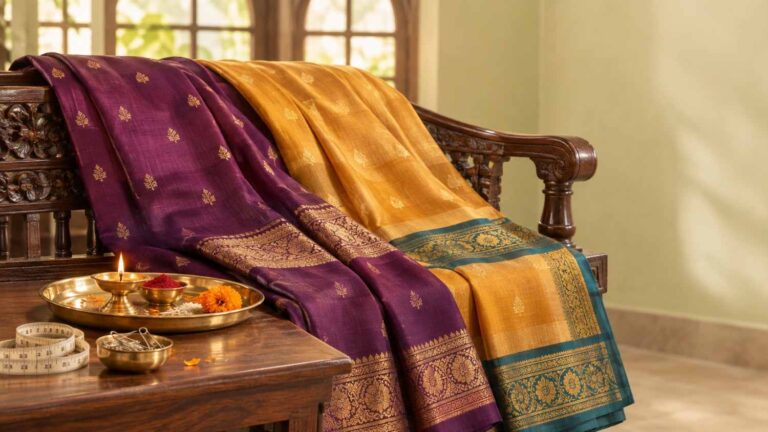
| Silk saree (Patola, Banarasi or Kanjivaram) | You wear sarees comfortably, or you will have a professional draper | Weight over a long day. Buy the saree first, because the blouse depends on the fabric in hand. |
| Silk or brocade anarkali or salwar suit | You are not a saree person, or you will be standing and moving a lot | Choose a formal fabric and floor length so it reads as ceremonial. |
| Lehenga-style set in a non-bridal colour | You want volume and ease of movement | Keep the embellishment a step below the bride’s, and avoid bridal red. |
| Indo-western (jacket set, dhoti or pant saree) | A reception or a more modern family | Gowns are usually a reception choice. Ask your family before wearing one to the ceremony. |
If you choose a saree, practise the Gujarati seedha pallu drape with the real saree and blouse. The pallu comes from the back over the right shoulder to the front, so the border and work show clearly. Our complete saree guide for Indian weddings explains the drape step by step.
If you plan a Patola, know what you are buying. Genuine Patan Patola is a double ikat silk woven in Patan, and it is registered as a geographical indication. The registry entry shows a certificate dated 9 September 2013, held by the Patan Double Ikat Patola Weavers Association.
See the GI collection entry. If a seller says “Patan Patola”, ask for documentation. Patola-style sarees from elsewhere are a different product.
If you prefer a suit or anarkali, see our designer salwar kameez collection.
Garba night and reception
Garba night. Many mothers join in. Choose something built to move: a chaniya choli or another full-skirted set, or a light suit. Test it by spinning and raising your arms before you commit. Our Navratri chaniya choli planning guide covers fit and movement in detail.
Reception. A modern silhouette is often welcome here. Options include a jacket set, a pre-draped saree or an evening gown-style outfit. Lighter fabrics such as organza or georgette keep you comfortable through a long standing evening. Our guide to Indo-western outfits for specific functions will help you compare silhouettes.
Daytime family functions
- Engagement: a polished silk saree or a rich suit, formal but lighter than the wedding.
- Pujas (Mandap Muhurat, Grah Shanti): simple and secure, in soft silk or cotton silk.
- Pithi: turmeric-friendly, in yellow or lighter shades.
- Gruhapravesh (groom’s mother): a second dignified outfit that is easy to move in.
If you wear one saree to two of these, change the blouse and the jewellery to make it look different.
Comfort check: the one-hour dress rehearsal
A ceremony day is long. Before the final fitting, dress completely, including shoes, jewellery and pins, and do the following.
- Stand for 15 minutes, as you would at the entrance for the Ponkhvu.
- Sit on the floor and on a chair, as you would for the pujas and the ceremony.
- Raise both arms to bless the groom or hold a thali. The sleeves should not pull and the pallu should not slip.
- Climb a few stairs with the hem in your hand.
- Move as you would on Garba night, if you plan to dance.
- Wear the full outfit for an hour. If anything itches, pinches or needs constant fixing, tell your tailor at the next trial.
Three points make this easier.
- The blouse decides the comfort. It has to let you sit, lift your arms and breathe. Our designer blouse masterclass covers measurements, trials and lining.
- Heavy handwork adds weight. If the day is long, place the embroidery where it shows and keep the rest light. Our guide to heavy versus light embroidery explains how.
- The season matters. IMD’s Ahmedabad climate note shows that daytime maximum temperatures ease through December, from about 31°C at the start of the month to about 27°C by the end. See the IMD Ahmedabad climate summary, and compare your wedding month before choosing fabric weight. Break in your shoes and carry a small pin kit.
Timeline and budget
When to start
Start about eight weeks before the wedding. Our custom outfits are usually completed in 2–6 weeks, depending on design complexity, embroidery and fittings, and ready-to-wear pieces are available within 3–7 days. This schedule is built on that range. It is not a guarantee, so ask for your delivery date in writing.
| When | What to do |
|---|---|
| 8 weeks out | Hold the three conversations. Collect the couple’s outfit photos. Decide how many outfits you need. |
| 6–8 weeks out | Buy any saree or fabric. Book a consultation. Choose silhouettes and colour families. |
| 4–6 weeks out | Place custom orders. Allow longer for heavy embroidery. |
| About 3 weeks out | First trial. |
| 1–2 weeks out | Final trial and alterations. |
| The final week | Do the one-hour dress rehearsal. Break in your shoes. Pack your pin kit. |
If you are buying a handloom saree, ask whether it carries the Handloom Mark. The scheme is promoted by the Development Commissioner (Handlooms), with the Textiles Committee as the implementing agency, and the Textiles Committee’s scheme page explains it.
For timing across the season, see our guide to the best time to shop for bridal wear in Ahmedabad. If the wedding is closer than four weeks, talk to us early about ready-to-wear and simpler embroidery.
How many outfits
A full Gujarati sequence can run to ten or more functions. You do not need an outfit for each. As a planning estimate:
| Tier | Functions | Approach |
|---|---|---|
| Essential | Wedding day, reception | Commission these properly. |
| Recommended | Garba night, the Mameru or Pithi day | New outfits if budget allows. |
| Flexible | Engagement, pujas, Gruhapravesh | Re-wear or restyle with a different blouse and jewellery. |
That is about four new outfits plus one or two restyled. It is a starting point, not a rule.
What drives the cost
Our homepage FAQ gives a general range from ₹3,500 for casual kurtis and tops to ₹2,50,000+ for luxury Indo-western and bridal outfits. We have not published a separate price list for mothers’ outfits, so ask at your consultation.
Cost each outfit as fabric plus handwork plus stitching plus blouse plus alterations. Then decide which outfit gets the largest share. For many mothers that is the wedding day, though you should decide this for yourself.
Ask for an itemised estimate before you pay an advance. Our guide to what to ask a bridal boutique before booking lists the questions about fittings, delivery and alteration policies.
Situations that need a different plan
You have never worn a saree. Nothing says a saree is compulsory, and many mothers choose a formal suit or anarkali. If you do want a saree, arrange professional draping on the day and practise in the blouse beforehand. Pre-draped sarees hold their pleats, but check with your family before wearing one to the ceremony.
You are not Gujarati. Use the role map and ask three questions: which functions you are expected at, whether any colour is avoided, and what the other mother plans to wear. A silk saree or suit in a jewel tone is a safe starting point. Avoid white, bridal red and white-and-red.
You are travelling from abroad. We offer nationwide and international delivery. Plan to arrive with time for a final trial and alterations. Our guide to ordering from Ahmedabad when you live abroad explains how a managed order works, though it is written for lehengas.
You have a family piece. If you own an older Patola, Gharchola or silk saree, bring it to your consultation and ask what can be done with it. We cannot promise an outcome without seeing the fabric.
If you are buying a new Gharchola, note that it received a GI tag in November 2024. The Government of India granted it, bringing Gujarat’s total to 27 GI tags, as reported by DeshGujarat. Ask sellers what documentation they can show.
Planning both mothers’ outfits with Fashion Autograph
If you are planning outfits for one or both mothers, a consultation is the easiest way to coordinate them. We design and stitch custom outfits in-house, handle alterations, and offer private consultations with our designer. Bring:
- Photos of the bride’s and groom’s outfits for each function.
- The palette and your list of functions.
- Your saree or fabric, if you have chosen it, and any family piece.
- Your jewellery.
To book, contact us. We are in Manek Baug, Ahmedabad.
Frequently asked questions
What should the mother of the bride wear to a Gujarati wedding?
For the ceremony, a silk saree, a formal anarkali or suit, or a lehenga in a non-bridal colour. Keep the embellishment a step below the bride’s and the colour clear of her red and the Panetar’s white-and-red. Lighter outfits suit the pujas, Pithi and daytime functions.
What should the mother of the groom wear?
The same principles apply. Ask the bride’s family for their palette before choosing, and plan a second dignified outfit if your family welcomes the bride at Gruhapravesh.
Can mothers wear red, white or black?
Deep maroon or wine is common, but avoid anything near the bride’s red or a red Gharchola. White and ivory are generally avoided at the ceremony, and many families avoid black. Ask rather than assume.
Is a saree compulsory?
No. Many mothers wear a formal suit or anarkali. If your family expects a saree for the ceremony, ask the elders.
How early should I order?
Start about eight weeks before the wedding. Custom outfits here usually take 2–6 weeks, and heavy embroidery takes longer.