The short answer: if your engagement is a family-led ceremony with elders, rituals and a lot of sitting, a saree or a lightweight lehenga is the safer choice. If it is an evening event with photographs and a modern crowd, a lehenga with a structured blouse or an Indo-Western gown fits better.
What decides it is not your favourite photograph. It is how long you will wear the outfit, where you will sit, the weather, what your family expects, and how many days you have left.
| If your engagement looks like this | Lean towards | Why |
|---|---|---|
| A home or family-hall ceremony, with elders leading and a lot of sitting | A saree, or a light lehenga with a modest dupatta | Both are familiar to a family audience and can be arranged for floor seating |
| An evening banquet or hotel event, with photos and a modern family | An Indo-Western gown, a lehenga with a structured blouse, or a pre-draped saree | Easier to move through a crowd, and the shape photographs well in evening light |
| A warm day, an outdoor venue or long hours | A lehenga in organza or net with the heavy work on the blouse and border, or a light saree | Fabric and embroidery weight tire you more than the garment’s name |
| Dancing is planned | A lehenga or a pre-draped saree you have tested moving in | You need room to move without holding the outfit up |
| Fewer than two weeks left | Ready-to-wear with alterations | Custom work needs fittings |
| You do not know what your family expects | Ask before you shop | Finding out after you buy is the expensive way |
Scope note: this guide is about the engagement. If you are choosing your main wedding outfit, read our comparison of bridal lehenga vs saree vs wedding gown. The two decisions overlap, but an engagement is shorter, more intimate and more flexible.
Which engagement are you dressing for?
“Engagement” covers several events, and what you wear depends on which one you have.
| Term | What it usually means | Why it matters for your outfit |
|---|---|---|
| Sagai / ring ceremony | The exchange of rings between the couple | Often the most photographed moment, so hands, neckline and sleeves matter |
| Gol Dhana | The Gujarati engagement ceremony, named for gol (jaggery) and dhana (coriander seeds) | Usually family-centred, so your family’s expectations carry weight |
| Chandlo Matli | A Gujarati ceremony of formal acceptance, often described as the point where the wedding date is fixed | Can be a separate, more formal occasion from the ring exchange |
| Engagement party | A social celebration hosted by the family or the couple | Closest to a party outfit, with the most freedom |
Published guides do not agree on how these ceremonies run, and families differ too. Aza’s guide to Gujarati wedding traditions has the bride’s father visiting the groom’s home for Chandlo Matli, while Manyavar’s Gujarati ceremony guide has the groom’s family visiting the bride’s home. Aza also mentions the bride-to-be receiving a simple saree from her future in-laws at Gol Dhana. Treat any single description as one version, not the rule.
What this changes for your outfit:
- Where it happens decides how much sitting, standing and floor seating you will do.
- Who hosts decides who sets the dress expectation.
- Ritual or party decides how traditional the outfit should be.
- Gifted pieces: if your family gifts a saree or another garment, ask whether you are expected to wear it.
For what the families around you might wear, see our guide to outfits for the mother of the bride or groom at a Gujarati wedding.
Five questions that decide it
Answer these in order. For most brides the answer is clear by the third.
- Who is in the room? If elders and relatives dominate and the tone is traditional, a saree or a lehenga is the safer reading. If it is a friends-and-family evening, a gown becomes a real option.
- How long will you wear it, and what will you do in it? Sitting through a ritual, greeting guests, standing for photographs and dancing each put different demands on the same outfit.
- What are the weather and venue? A hot afternoon, an air-conditioned banquet and a crowded home are three different problems.
- What does your family expect? Ask directly. A short conversation now prevents an expensive change later.
- How many days do you have? Time narrows the options faster than taste does.
If your answers split between two outfits, the comparison table further down will break the tie.
Lehenga for an engagement
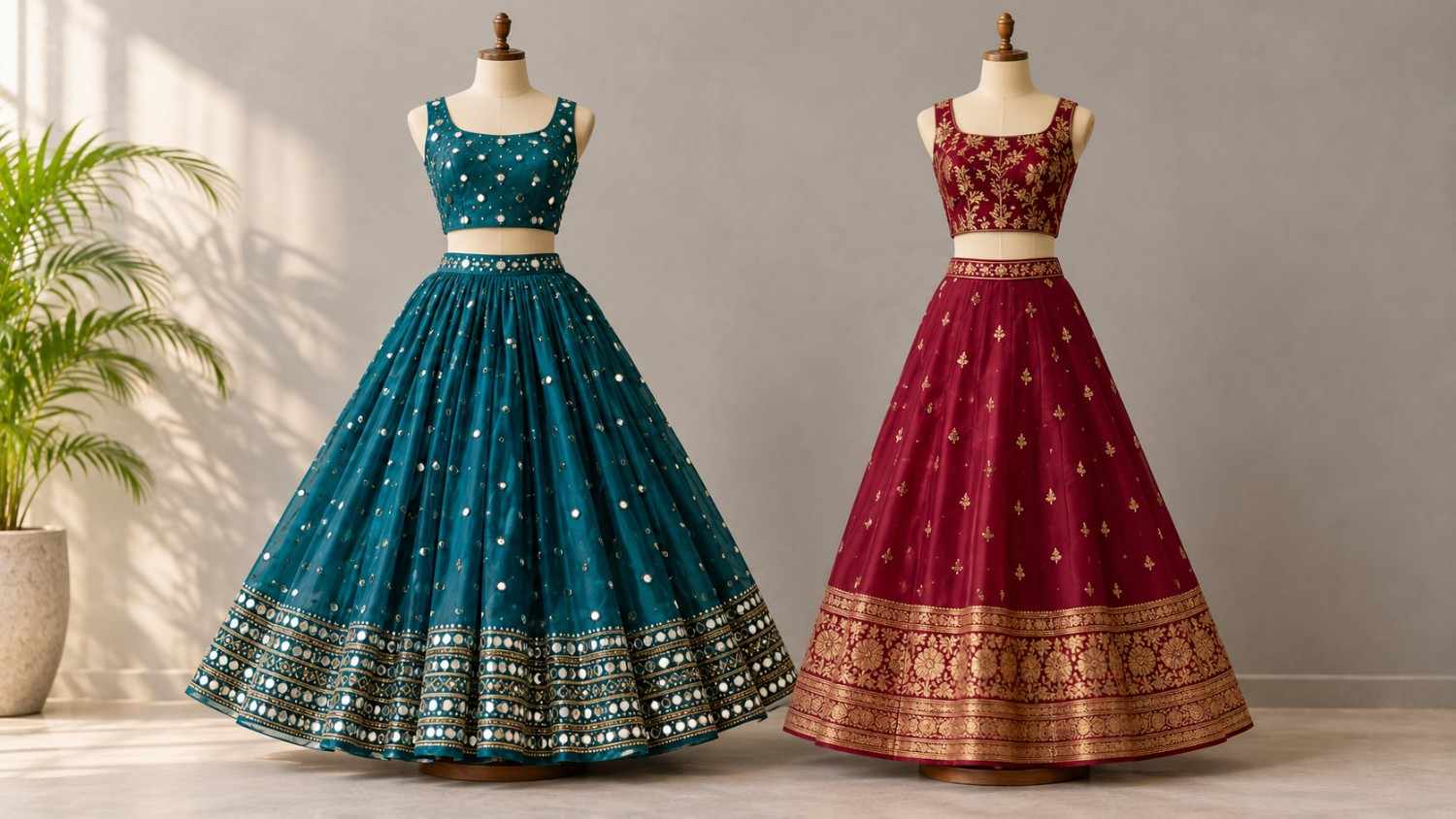
A lehenga gives you volume, structure and a clearly festive look. It suits a bride who wants the engagement to feel special without wearing her wedding look early.
It works well when:
- The ceremony is formal and you want a classic, celebratory look.
- You want room for embroidery on the blouse, border and dupatta.
- You will dance, since a well-fitted lehenga moves with you.
Watch for:
- Weight and heat. The skirt, the can-can underskirt and dense embroidery all add weight. Ask for the finished weight and the lining details before you approve a design, and wear the outfit for at least half an hour at a trial.
- Seating. A full skirt needs space. If you will sit on the floor, check how it falls when you sit.
- Too bridal too soon. Heavy red-and-gold work can pre-empt the wedding look. Lighter embroidery or a different colour keeps the engagement distinct.
- Changes before the date. If your weight may change, ask about alterations. We offer alterations so an outfit keeps up with weight fluctuations.
To keep a lehenga light, choose organza or soft net for the skirt, put the heavy work on the blouse and border, and keep the panels light. Our post on heavy vs light embroidery explains how to choose by hours worn. You can also see our bridal lehenga collection for the kind of work we make to measure.
Saree for an engagement
A saree is the most expected choice at a traditional family engagement, and a rich silk saree can return for later weddings and pujas.
It works well when:
- Your family expects a traditional look.
- The ceremony involves long sitting and you do not want skirt volume.
- You like the idea of wearing the piece again.
Watch for:
- It is not automatically easier. A saree is often lighter than a heavily worked lehenga, but a rich silk saree with a heavy pallu is not light, and pinning and the drape take practice. Rehearse the drape before the day.
- The blouse decides the fit. Because it is the one fitted piece, the blouse determines how the whole outfit sits. A classic blouse keeps it traditional, while a structured or cape blouse can make a simple silk saree look modern. We design saree blouses to measure, and our designer blouse masterclass covers what to check at each fitting.
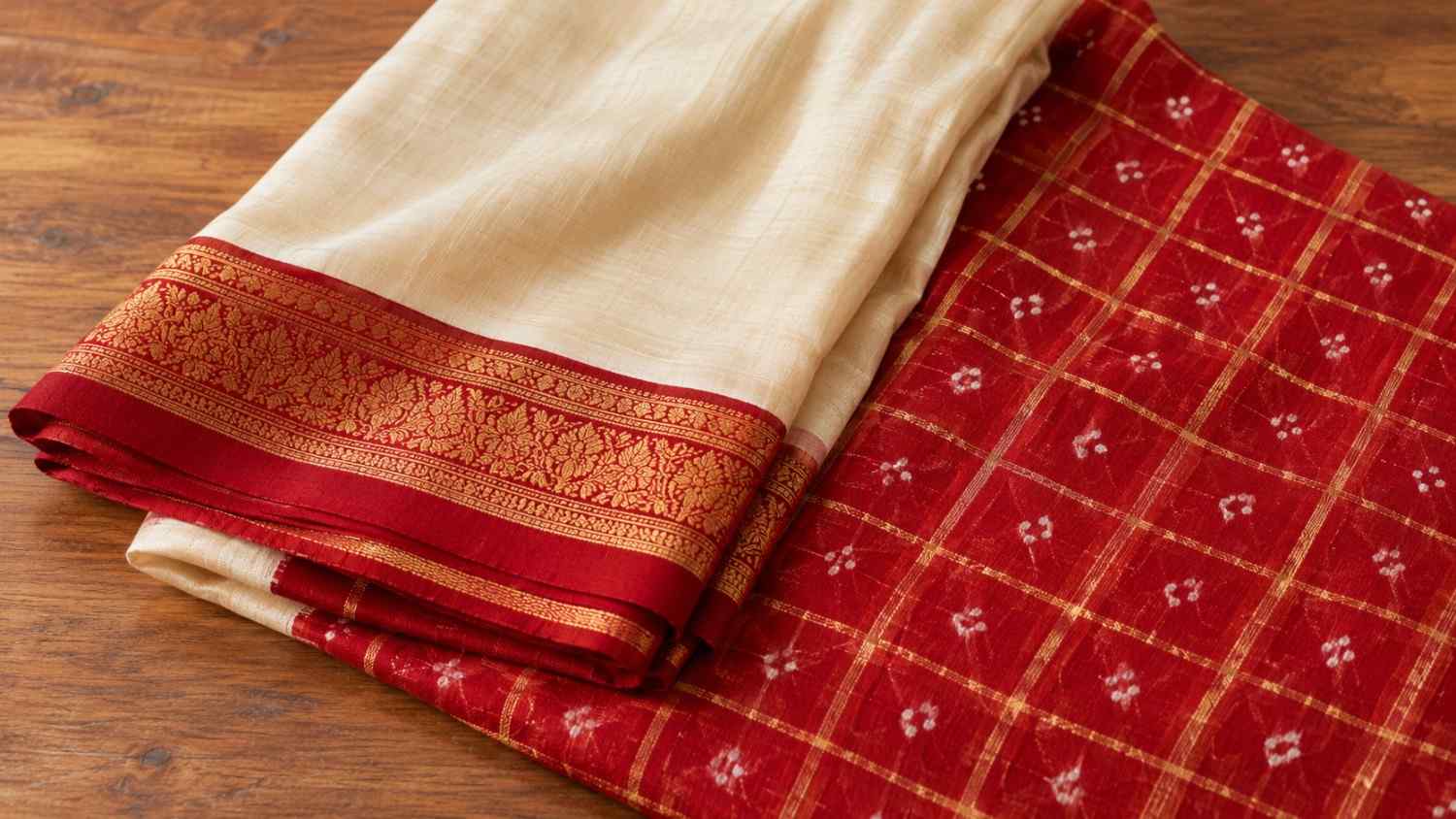
- Wedding-function sarees. The Panetar (a white or off-white saree with a red border) and the Gharchola (a bandhani saree) are associated with the wedding functions. WeddingWire India’s Gujarati wedding guide describes both. Ask your family before wearing either, or anything that imitates them, to an engagement.
Gown for an engagement
“Gown” means several different things at Indian engagements, so decide which one you mean.
| Term | What it is | Best for |
|---|---|---|
| Western white gown | A Western-style dress with little or no Indian detail | A church ceremony or a Western-style evening |
| Indo-Western gown | A Western silhouette with Indian embroidery, a dupatta-style drape or a jewel tone | An engagement party, banquet or evening event |
| Anarkali gown | A long, flared, kurta-style gown | Daytime and family settings where you want more coverage |
| Saree gown | A stitched piece with the look of a saree drape | A saree look without draping |
| Pre-draped saree | A saree stitched into pleats for quick dressing | Saves dressing time and pinning worry |
| Lehenga saree | A pre-stitched saree that looks like a lehenga | A middle ground between the two |
A gown works well when the event is in the evening, the family is relaxed about dress, and you want a modern line. Check two things first:
- Family expectation. If the engagement is a home ritual, ask your elders.
- Fit. A gown is cut close through the bodice and has less give than a saree or lehenga. Make sure you can sit, climb stairs and raise your arms. A narrow skirt is the most restrictive for floor seating.
Our Indo-Western range includes gowns, fusion dresses, draped saree gowns and crop-top lehengas, all made to measure.
Side by side
| What matters | Lehenga | Saree | Gown (Indo-Western) |
|---|---|---|---|
| Fits a traditional family setting | Yes | Yes, the most familiar | Depends on the family; check first |
| Sitting, including on the floor | Needs space; depends on the skirt | Comfortable once well pinned | Most restrictive unless the skirt is full |
| Standing and photographs | Strong, structured shape | Elegant; depends on the drape | Clean line; test the fabric and embellishment |
| Dancing | Good once fitted | Good in a pre-draped style | Good if the skirt is not narrow |
| Weight and heat | Set by fabric, can-can and embroidery | Set by fabric and embroidery | Set by fabric and lining |
| Where fitting effort goes | Blouse and skirt waist | Mostly the blouse | The whole bodice |
| Re-wear | Restyle with a new blouse or dupatta | Strong for later functions | Depends on how heavy the embellishment is |
Weight and lead time depend more on fabric and embroidery than on the garment’s name. A simple lehenga can weigh less than a heavily worked saree, and the reverse can also hold.
Ahmedabad: season, venue and colour
Season. In the hotter months, choose organza, georgette or lightweight silk and ask for a breathable lining. In winter, velvet and heavier silks become comfortable choices. Our guide to fabrics for Ahmedabad weddings goes into detail by season.
Venue.
- Air-conditioned banquet or hotel: heavier fabrics are comfortable, but you will move through crowds and need freedom in the skirt.
- Open lawn or outdoor space: choose lighter fabrics and watch for uneven ground and a long hem.
- Home or family hall: it can be crowded and warm, with a lot of sitting. Lashkaraa’s engagement guide notes that a home ceremony may involve sitting on the floor and that venue-appropriate footwear matters. The same applies to you as the bride.
Colour. Red is the traditional wedding colour, so some brides choose a softer or different shade for the engagement. WedMeGood’s gallery of real engagement looks shows how many brides use pastels and lighter palettes. Colour customs vary by family, so ask your elders, particularly before choosing white or ivory.
How much time do you have?
Time often decides the question. Custom outfits are usually completed in 2–6 weeks, depending on design complexity, embroidery and fittings. Ready-to-wear pieces are available within 3–7 days. Heavily embroidered pieces can take longer than the usual range.
| Time before the engagement | Realistic route | Confirm |
|---|---|---|
| About a week or less | Ready-to-wear with alterations | Which pieces are available and the fitting slots |
| Two to six weeks | Custom or ready-to-wear; embroidery and fittings decide | Embroidery level, number of fittings and the delivery date |
| Six weeks or more | Room for heavier embroidery and more trials | Trial schedule and a buffer for adjustments |
Always get your delivery date in writing. Our guide to custom bridal outfits vs designer ready-to-wear explains what you gain and give up with each route.
Budget, and the cost-per-wear test
Price depends on what goes into the outfit: fabric, embroidery hours and construction. Extras add up: a blouse, can-can, lining, dupatta finishing, a saree’s fall and pico, and alterations. To compare fairly, ask for quotes for each option in the same fabric and at the same level of embroidery. Then the quotes show the real difference.
A simple way to think about value is cost per wear:
Cost per wear = total cost ÷ number of times you will wear it
Example arithmetic with round numbers, not a quote: an outfit costing ₹60,000 that you wear four times works out to ₹15,000 per wear. An outfit costing ₹30,000 that you wear once works out to ₹30,000 per wear. The cheaper outfit can cost more per wear.
That does not mean you should buy the more expensive one. It means a piece you can restyle deserves a place in the comparison. A lehenga can return with a new blouse or dupatta, and our guide to re-wearing or restyling a bridal lehenga shows how. Spend most on the piece that you and your family see for the longest.
Before you decide: a checklist
Ask your family
- Where is the engagement, and who is hosting?
- Is there a ritual component, and is there a dress expectation?
- Are there gifted pieces, such as a saree, that you are expected to wear?
- Are there colours to avoid or to prefer?
- What will the groom and his family wear? Matching tones look deliberate, while clashing ones look accidental.
Test your shortlist. Wear each outfit and run a four-move test:
- Sit down, on a chair and on the floor if relevant.
- Climb a flight of stairs.
- Raise both arms.
- Move or dance for a minute.
Then stand still for a few minutes with your hands in front of you, as you will for the ring exchange.
Ask your boutique
- What is the finished weight, and what is the lining?
- How many trials do I get, and when?
- What is the delivery date, in writing?
- What happens if I need alterations close to the date?
Choose with a designer, not alone
If you are still deciding, try two silhouettes from each category in front of a mirror and judge them in photographs. At Fashion Autograph, you can book a private consultation with Naimisha Munshi to compare options for your date, venue and family. Bring photos of outfits you like, your jewellery and an honest budget. Book an appointment with Fashion Autograph
FAQs
Can a bride wear a gown to a Gujarati engagement?
Yes. Brides do wear Indo-Western gowns, particularly for evening or banquet-style engagements. If the engagement is a home ritual, check with your elders first, because expectations differ by family.
Can I wear white, ivory or red to my engagement?
Colour customs vary by family and community. Red is the traditional wedding colour, so some brides choose another shade for the engagement. Ask your elders before choosing white or ivory.
How early should I order?
As soon as you choose the outfit. Custom outfits are usually completed in 2–6 weeks and ready-to-wear pieces are available within 3–7 days. Heavy embroidery can take longer, so get the delivery date in writing.
Can I wear my engagement outfit again?
Often, yes. A lehenga or saree can return with a new blouse or dupatta. A heavily embellished gown may have fewer second wears.