
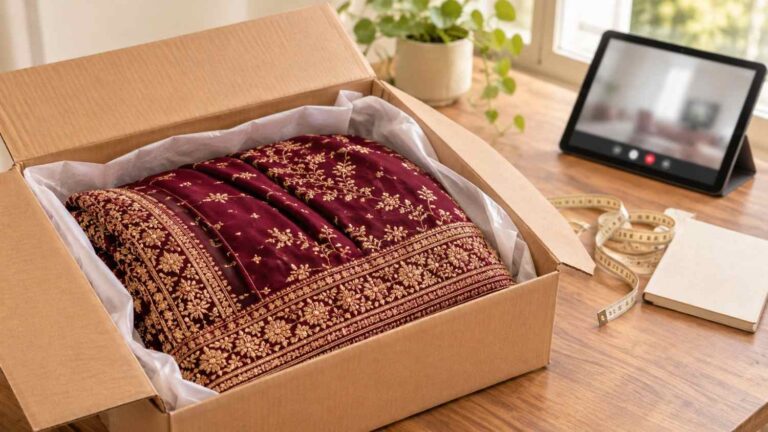
Yes, you can. A custom bridal lehenga can be designed, measured, made and delivered without you visiting Ahmedabad. But it works as a managed project, not as an online order, and what decides whether it works is fit, not shipping.
Three things should be settled before you pay a deposit:
- A timeline planned backwards from your wedding date, with a buffer for fixing anything that arrives wrong.
- Measurements that your boutique verifies rather than simply accepts.
- A written answer to one question: if it doesn’t fit when it arrives, what happens, and who pays?
How early? Plan in months, not weeks. Studios that publish guidance for overseas brides mostly advise starting three to six months ahead, and some advise longer. Your own date comes from the calculation in the timeline section below.
This guide is for brides in the US, UK, Canada, Australia, the Gulf and elsewhere, whether you’re marrying abroad or in India.
Is ordering remotely the right route for you?
Remote ordering is one of three realistic routes. The right one depends mostly on where your wedding is and how much time you have.
| Route | Suits you if | Main risk |
|---|---|---|
| Fully remote: design, fit checks and delivery all at a distance | Your wedding is abroad, or you can’t be in India beforehand | The lehenga is on your body for the first time only after it has crossed a border |
| Remote design, final fitting in Ahmedabad | Your wedding is in India, or you’ll be in Gujarat before it | Arriving too close to the wedding leaves no time to fix anything |
| Ready-made or designer piece | Your timeline is very short, or you want to try before you buy | Less control over fit and design, and more alterations. See custom vs designer RTW |
Think twice about remote ordering if:
- Your wedding is closer than the boutique’s written minimum lead time. Rushed work on a heavily embroidered piece is where quality and fit suffer.
- Your weight is likely to change noticeably before the wedding.
- You want a closely structured or boned blouse and have never had one fitted. Our designer blouse masterclass explains why the blouse decides how the whole outfit sits.
- You have nobody to help with measurements, no skilled tailor within reach after delivery, and no way to travel.
If one or two of these apply, you may still be fine. They are the points to raise on your first call.
How a remote order works, step by step
The useful question isn’t “do you ship abroad?” but “what do I receive at each stage, and what must I approve?” This is the sequence to expect.
- Consultation. You share your wedding date, functions, venue, reference images, budget and jewellery plans. At Fashion Autograph, bridal design begins with a personal consultation with Naimisha Munshi.
- Design brief. Agree the silhouette, neckline, blouse, dupatta, and which embroidery goes where.
- Fabric and colour approval. Screens misrepresent colour, so ask for daylight video or swatches.
- Measurements. Your body measurements, taken and verified (next sections).
- Written order and deposit. Fashion Autograph takes a 50% deposit at booking on bridal orders, with the balance on delivery or final fitting.
- Production, with dated proof of progress.
- Pre-dispatch review. The finished garment is checked on camera before it leaves.
- Dispatch, customs and delivery.
- Try-on and any fixes.
For the in-person version, see what to expect in our custom bridal lehenga process.
Work backwards from your wedding date
A fixed wedding date is the one thing you can’t move, so plan from it. Published advice for overseas brides varies widely. One retailer quotes 2–8 weeks for delivery of a bridal outfit, another says custom orders take 12–16 weeks and advises starting 6–9 months ahead, and a studio recommends 4–6 months for overseas brides. That spread isn’t confusion. It reflects three variables that differ from order to order:
- How much hand embroidery the outfit carries. This is the biggest driver. Our embroidery guide explains why zardozi and gota patti take different time.
- How busy the workshop is in your wedding season. Winter dates fill production calendars.
- How many review rounds you build in.
So don’t adopt anyone’s average, including ours. Get the production time for your design in writing, then do the arithmetic.
- Start from your wedding date.
- Subtract your buffer: time to try the lehenga on and fix problems, plus slack.
- Subtract shipping and customs time.
- Subtract the pre-dispatch review.
- Subtract production time for your design.
- Subtract design, fabric approval and measurement time.
The result is the latest date to start. If your date is fixed by muhurat, treat it as a deadline, not a target.
Illustration only. The durations below are assumptions, not a Fashion Autograph quote. Each date is when that stage must start, or, for arrival, be complete.
| Stage | Assumed duration | Latest date (wedding on 14 Nov 2027) |
|---|---|---|
| Arrives with you, for try-on and fixes | 4 weeks before the wedding | 17 Oct |
| Dispatch, covering transit and customs | 2 weeks | 3 Oct |
| Pre-dispatch video review | 1 week | 26 Sep |
| Production | 12 weeks | 4 Jul |
| Design, fabric and measurements | 3 weeks | 13 Jun |
That is roughly 22 weeks, about five months, from first consultation to the wedding. A denser embroidery plan stretches production. A customs delay eats your buffer, which is its purpose.
A local order doesn’t have shipping, customs or a remote review loop to absorb, so overseas timelines are naturally longer than those usually quoted for in-person orders. See also the bridal lehenga buying guide on getting production time in writing.
Taking measurements without a tailor beside you
Give your boutique your body measurements, not the size you think the garment should be. Ease, the room that lets you breathe, sit and raise your arms, is the cutter’s job. Adding your own makes any error harder to trace.
- Ask someone to measure while you stand naturally. One person measures and the other writes.
- Wear thin, fitted clothing and the bra or shapewear you plan to wear on the day.
- Measure in your wedding heels for length.
- Keep the tape level and snug, not pulling.
- Measure twice on different days. If the numbers differ, send both and say so.
- Record centimetres and inches.
- If your boutique asks for front, side and back photos in fitted clothing, take them in good light.

| Measurement | How to take it | Common mistake |
|---|---|---|
| Bust | Around the fullest part, tape parallel to the floor | Measuring over a padded bra you won’t wear |
| Underbust | Directly under the bust | Skipping it. Structured blouses depend on it |
| Waist | Narrowest point, plus where you want the skirt to sit | Assuming these are the same place |
| Hip | Fullest part | Measuring too high |
| Shoulder | Shoulder tip to shoulder tip across the back | Letting the tape sag |
| Armhole | Around the arm where the sleeve joins | Measuring too tightly, which restricts arm movement |
| Sleeve length | Shoulder edge to where you want the sleeve to end | Not deciding the style first |
| Blouse length | Shoulder to where you want the blouse to end | Forgetting where the skirt sits |
| Neck depth, front and back | From the shoulder line down | Choosing before your jewellery is decided |
| Lehenga length | Waist to floor, wearing wedding heels | Measuring barefoot |
Decide your jewellery before the blouse is cut, because the neckline frames it. Our guide on choosing bridal jewellery to complement heavy embroidery covers this.
Ask when your measurements are locked and what a change costs after that point. If your weight shifts, tell the boutique early. For more on how measurements and trials shape a custom lehenga, see how to ensure a perfect fit.
What a video fitting can and cannot tell you
“Video fitting” gets used loosely. A video call can confirm a lot, but it isn’t a trial on your body.
| Checkpoint | When | A video can confirm | A video cannot confirm |
|---|---|---|---|
| Design and fabric review | Before production | Layout, embroidery placement, how the fabric moves | True colour. Screens distort it, so ask for swatches or daylight footage |
| Measurement check | Before cutting | That the tape is level, snug and placed correctly | Your posture and balance without photos |
| Pre-dispatch review | Before shipping | Finish, symmetry, hem, hooks, lining, embroidery quality | How it sits on your body, unless it’s tried on |
| Try-on after delivery | On arrival | Whether a fix is needed, and what kind | Subtle problems you can’t see on camera. Fixes now need local help |
Set up the call:
- Good light and a full-length mirror.
- A phone on a stand or held by a helper at hip-to-chest height.
- The shapewear, bra and heels you’ll wear on the day.
- Hair and jewellery as planned.
- A notepad for decisions. Record the session only if both sides agree.
A video can’t show how the blouse behaves when you raise your arms, whether the waistband digs after two hours, or how heavy embroidery pulls on the fabric. Those only show up when you wear the finished lehenga. That is why seam allowances and an agreed fix plan matter more than the call itself.
If it doesn’t fit when it arrives
Overseas brides do report problems, such as blouses that didn’t fit despite measurements being taken, and production that began later than promised. You prepare for this by agreeing the recovery plan before you order. Don’t assume a return is possible either: custom bridal wear is rarely returnable across borders.
The first 48 hours after delivery
- Photograph the box and packaging as they arrive.
- Check every item against your order sheet: lehenga, blouse, dupatta, can-can, lining, hooks.
- Try everything on with the shapewear, bra and heels you’ll wear.
- Photograph or film front, side and back, with your arms raised and while seated.
- Send the images to the boutique the same day, with specific notes.
- Don’t let any tailor cut until the maker has advised. Alterations can limit what can be fixed afterwards.
What can usually be fixed locally. This is a general guide. How a piece was built decides the real answer.
| Issue | Usually fixable locally? | Notes |
|---|---|---|
| Blouse slightly loose | Usually yes | Taking in is the easier direction |
| Blouse slightly tight | Depends | Needs enough seam allowance and a suitable embroidery layout |
| Skirt waist too loose or tight | Often | Adjustable via ties, hooks or waistband, within limits |
| Hem too long | Often | Border embroidery may need careful handling |
| Hem too short | Rarely | Only where a hem allowance exists |
| Flare or panel width | Difficult | Cuts through embroidery |
| Neckline, back depth, armhole shape | Risky | Structural, so best returned to the maker |
Blouse adjustments are among the more manageable alterations if enough seam allowance was built in, while resizing a heavily embroidered skirt needs a tailor with direct experience of Indian garments.
One retailer that ships to the US notes that most local tailors lack experience with lehengas. One studio says major structural problems would mean returning the piece to India.
So find your tailor before you order. Show them a similar outfit if you can, and ask what they would need, such as seam allowance and lining details. If your blouse is harder to fit, see lehenga for heavy bust and short-torso proportion tricks.
Shipping a bridal lehenga internationally
A bridal lehenga is bulky, valuable and dutiable. It isn’t a small garment parcel, so generic “10–20 business day” figures for ordinary clothing don’t apply. Fashion Autograph offers international delivery, so ask which courier and cost will apply to your destination. Also ask about:
- Service and tracking. Courier with tracking and a signature on delivery. Ask which service is used. Postal routes to the US are in transition: CBP’s 2026 rule created a new postal entry process and acknowledged possible short-term interruptions while filers adapt.
- Insurance for the full invoice value.
- Delivery address. A home you’ll be at, or a trusted person’s, with a phone number the courier can use. Avoid addresses that can’t receive high-value parcels.
- Packaging. Ask for photos before it leaves.
- Timing. Festive peaks such as Diwali are busy for couriers, so build in slack.
For wedding-trip packing rather than shipping, see travelling with a bridal lehenga safely.
Customs, duty and VAT: what to expect in 2026
Duties and taxes are the part of this topic most likely to have changed since the last article you read. Don’t rely on figures from older blogs.
| Destination | What to know (as of 4 November 2026) | What to check |
|---|---|---|
| United States | Duty-free de minimis treatment for shipments of $800 or less is suspended, with statutory repeal due 1 July 2027. Shipments up to $2,500 use informal entry, and higher values need formal entry. The gift exemption is capped at $100, so it won’t cover a bridal lehenga you buy for yourself. Duty rates on Indian apparel changed several times in 2025–26, and sources disagree, so ignore older blog figures. | Ask the courier or broker for a duty estimate based on your invoice. Confirm on cbp.gov |
| United Kingdom | The UK–India trade agreement, in force since 15 July 2026, can reduce duty on qualifying goods but doesn’t remove import VAT. Most sources describe duty on qualifying Indian-origin clothing as zero. It applies only if origin is proven and the preference is claimed. VAT is 20%, and couriers may add a handling fee above £135. | Ask whether origin documents travel with the parcel and who claims the preference. See UK Trade Tariff |
| Canada, Australia, UAE, elsewhere | Thresholds, taxes and trade-agreement preferences differ and change often. We don’t print rates here. | Ask the courier for a destination estimate before you pay the balance, and confirm with CBSA, Australian Border Force or your local customs |
DDP vs DDU. Under DDP (delivered duty paid), the sender or courier collects duties up front. Under DDU, you pay on arrival. Neither is automatically better, but you should know which applies.
Worked example, UK, illustrative only. Say the lehenga is invoiced at £1,500 and shipping plus insurance is £200. UK import VAT is calculated on goods plus shipping, so on £1,700 at 20% you’d owe £340, before any duty or courier fee.
Four rules
- Declare the true value. Under-declaring to reduce duty can lead to delay, penalties or seizure.
- Keep the invoice and your contact details ready in case customs asks.
- Leave buffer for a hold. This is part of the timeline above.
- This section is general information, not customs or legal advice. Check current rules with the authority or your courier before you pay.
What it really costs
The lehenga is only one line. Plan for all of these:
- The lehenga. Fashion Autograph bridal lehengas range from ₹25,000 to ₹3,00,000+, depending on fabric, embroidery and customisation. Ask for an itemised quote covering blouse, lining, can-can, dupatta finishing and packaging, as our buying guide recommends.
- Shipping and insurance.
- Duty and VAT or GST at your destination.
- Local alterations. Get a quote from your tailor before you order.
- Contingency for a fix, a late change or a courier delay.
- Payment and currency fees.
For ways to protect your budget, see finding the perfect bridal lehenga on a budget.
Paperwork and proof of progress
A written order protects both sides. It should record:
- The design, with reference images.
- Fabric, embroidery type and placement.
- The measurement sheet version.
- The price and what’s included.
- Deposit and balance schedule.
- Dated commitments: design approval, dispatch.
- Rules for changes after approval.
- Remake and alteration terms.
- Shipping arrangements and who pays for what.
Ask for dated photos or video of your garment, not of a sample, at agreed stages. Confirm which payment methods work from your country before you fall for a design.
Wedding in India? Order from abroad, finish in Ahmedabad
If your wedding is in India, a hybrid works well. Finalise the design and measurements remotely, let production proceed, then schedule your final fitting soon after you land, with the cutters on hand. Fashion Autograph’s bridal bookings include 2–3 complimentary fittings.
The risk is arriving too close to the function. Ask how many days of fittings your design needs and plan to be in Ahmedabad that early. If you have several functions, ask whether outfits can be fitted together.
Starting your order with Fashion Autograph
Fashion Autograph has been designing since 1989, and its bridal page cites over 600 brides. You can see the bridal lehenga range and the work gallery first. When you’re ready to talk it through, contact the boutique or call +91 9374271847. Useful things to send at the start:
- Your wedding date and city or country
- The functions you need outfits for
- Reference images and colours you like or dislike
- Your budget range
- Your wedding-heel height
- Your jewellery plans
- Your destination country and delivery address
- Whether you’ll be in Ahmedabad before the wedding
For what to bring if you do visit, see the fitting checklist.
FAQs
Can my family in Ahmedabad inspect or collect it for me?
They can check finish, colour and embroidery, and help with collection or forwarding. They can’t stand in for your body, so don’t rely on a relative of similar size.
Can I change the design after approval?
It depends how far production has gone. Ask for the “lock points” in writing. Once cutting or embroidery starts, changes get harder.
What if customs holds the parcel?
Respond to the courier promptly, supply the invoice, and don’t undervalue. Your buffer should cover it.
Can I order other function outfits in the same shipment?
Often yes, such as a chaniya choli for garba. Combining items raises the declared value, so check how that affects duty and VAT.


