
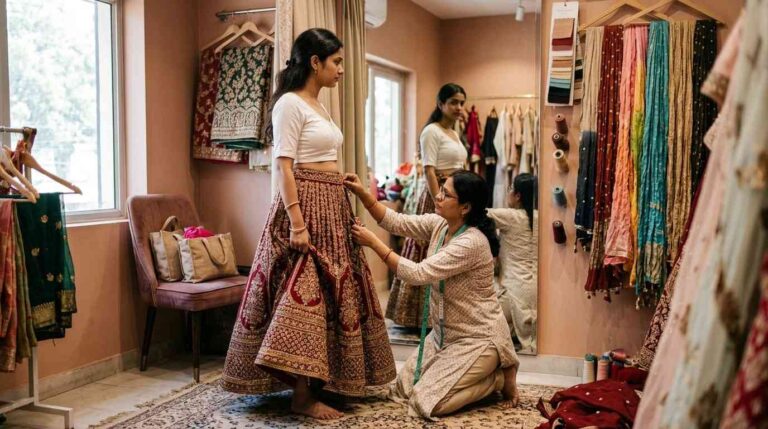
If you have a short torso, you already know the frustration. A lehenga that looks stunning on the mannequin somehow makes you look squashed in the middle when you try it on.
The waistband sits at the wrong spot, the choli feels too long, and the whole outfit throws your proportions off instead of flattering them. The good news is that this has nothing to do with your body being wrong.
It has everything to do with the outfit being cut for a different frame. Once you understand a few simple styling rules, you can pick a lehenga that lengthens your upper body, balances your silhouette, and photographs beautifully on your wedding day.
This guide walks you through exactly how to do that, step by step.
What “Short Torso” Really Means (And Why Standard Lehengas Don’t Fit Right)
Before you start shopping, it helps to understand what a short torso actually means and why it creates such a specific styling problem for lehengas.
How to Tell If You Have a Short Torso
A short torso simply means the distance between your shoulders and your waist is shorter compared to the length of your legs. You can check this at home.
Stand straight and measure from the base of your neck to your natural waistline, then measure from your waist to the floor. If your leg length is noticeably longer than your upper body length, you have a short torso.
This is completely different from being short in height. You can be tall with a short torso, or petite with a long torso, and the measurement is about ratio, not overall height.
Why Off-the-Rack Lehengas Fail This Body Type
Most ready-made lehengas are cut for an average torso length, which means the choli often ends up sitting lower than your natural waist and the skirt starts even lower still. This pushes the waistline down onto your hips, making your upper body look compressed and your legs look shorter than they are.
It is one of the most common fit complaints brides raise, and it is exactly why so many brides end up choosing a design that suits their frame rather than a trending style that does not.
If you want a wider look at how silhouette choices change for different body shapes, our guide on choosing the perfect bridal lehenga for your wedding day breaks this down in more detail.
The Choli Is Your Biggest Lever
Of every element in your bridal outfit, the choli has the single biggest impact on how long or short your torso appears. Get this right, and half your proportion problem is already solved.
Ideal Choli Length and Neckline for a Short Torso
A longline choli that sits just at or slightly below your natural waist works far better than a very short blouse for a short-torso frame. This length gives your upper body room to breathe visually instead of cutting it off too early.
Pair it with a V-neck, sweetheart, or deep-U neckline. These necklines draw the eye downward in a straight line, which reads as length rather than width.
Avoid high, boxy necklines that sit close to the throat, as they tend to shorten the visible torso even further.
Cropped Cholis: Helpful or Harmful for This Body Type?
Cropped cholis are everywhere in bridal inspiration right now, but they need to be used carefully if you have a short torso. A very short blouse that ends well above the waist exposes a large stretch of midriff, which can actually make your upper body look even more compressed once the high-waisted skirt starts.
If you love the cropped look, ask your designer to lower the hemline slightly and keep the exposed midriff to a narrow strip rather than a wide gap. This small adjustment keeps the trend without working against your frame.
Waistline and Skirt Placement Tricks
Once your choli length is sorted, the next biggest decision is where your skirt sits and how it flares. This single choice can add or remove visual inches from your torso.
High-Waist vs. Low-Waist: Which Elongates Better
For a short torso, a high-waisted lehenga skirt is almost always the better choice. When the waistband sits closer to your ribs rather than your hips, it visually extends your legs and gives your upper body a cleaner, longer line.
A low-waisted skirt does the opposite, since it shortens the torso further by starting the flare too early. If you are unsure about waistband placement and how it is measured, our anatomy guide covering the terms every bride should know explains exactly where each part of a lehenga sits on the body.
Best Skirt Flares and Hem Lengths for This Frame
A-line and gently panelled skirts work well because they flare out smoothly from the waist without adding bulk around the middle. Steer clear of heavily tiered or ruffled skirts, as the horizontal layers can pull focus toward your midsection.
On length, go for a hem that grazes the floor or the top of your feet. A skirt that stops mid-calf cuts your leg line short and takes away from the height you are trying to add.
For a broader look at silhouettes built around shorter frames, our silhouette guide for petite brides covers cuts that pair well with a shorter torso too.
Fabric, Embroidery, and Colour Choices That Add Length
The fabric and embroidery you choose work quietly in the background, but they can either support your proportion tricks or cancel them out completely.
Vertical Embroidery and Monochrome Styling
Choose embroidery that runs in vertical panels rather than horizontal bands across the waist or hip. Vertical booti work, straight borders, and panel embroidery all pull the eye up and down instead of side to side, which reads as added length.
Sticking to one colour family for both the choli and skirt, rather than a strong colour break at the waist, also helps keep the outline continuous. If you want ideas on shades that work well for 2026 weddings while still supporting this effect, have a look at our roundup of the top 10 bridal lehenga colour trends for 2026 weddings.
Fabrics and Patterns to Avoid
Stiff, heavy fabrics like thick velvet or brocade tend to hold their shape outward, which adds bulk exactly where you do not need it. Lighter fabrics such as georgette, organza, and chiffon fall closer to the body and drape in a way that keeps the silhouette streamlined.
Also avoid large horizontal motifs or wide contrasting waistbands, since both draw a visible line across your middle and shorten the torso in photographs.
Dupatta Draping and Accessorising for Balance
Your dupatta and jewellery are not just finishing touches. Used well, they reinforce every proportion trick you have already built into the lehenga.
Draping Styles That Elongate the Torso
A diagonal drape across the body, pinned at one shoulder, creates a long sloping line that adds visual height. Cape-style dupattas, which are popular in 2026 bridal looks, work well too, since they fall in a continuous vertical line rather than bunching at the waist.
Avoid wrapping the dupatta tightly around your middle or letting it sit in thick folds at the waistline, as this adds width exactly where you want length instead.
Jewellery and Hair Tricks That Reinforce the Illusion
Long necklaces or layered pieces that fall past the collarbone extend the line of your neck and upper body, while chunky chokers can shorten it. A soft high bun or a hairstyle with volume at the crown adds a touch of height without looking forced.
If you want a full breakdown of how to layer jewellery correctly with a lehenga, our guide on accessorising a bridal lehenga for a regal look covers necklace lengths, earring styles, and how to avoid overloading the neckline.
Custom Tailoring: Why It Matters More for This Body Type
Every trick above works far better when the lehenga is actually made to your measurements rather than adjusted after the fact from a standard size.
Alterations That Make the Biggest Difference
For a short torso, three adjustments matter most: the choli length, the exact waist seam placement, and the rise of the skirt. Even a shift of an inch or two in any of these spots changes how balanced the outfit looks on you.
This is why a proper trial fitting matters so much. Our process for ensuring a perfect fit for your custom bridal lehenga is built around getting these small measurements right before the final stitching begins.
What This Typically Costs in Ahmedabad (2026)
Pricing for a custom bridal lehenga in Ahmedabad depends on several factors, including the fabric quality, the amount of hand embroidery, the number of fitting sessions, and how much custom work goes into the choli and waistline adjustments specific to your body.
Because these variables shift the final cost quite a bit, it is worth understanding what actually drives the price before you set a budget. Our detailed price breakdown covering what changes the cost of a bridal lehenga walks through each of these factors so you know what you are paying for at every stage.
Common Mistakes Short-Torso Brides Make
Even with the right silhouette in mind, a few small styling choices can quietly undo all the proportion work you have put in.
Styling Choices That Undo All the Proportion Tricks
Layering a thick belt or kamarbandh directly over an already high waistband adds another visual break at the middle, which shortens the torso again. Choosing a trending silhouette purely because it looked good on someone else, without checking if it suits your own torso length, is another common trap.
So is skipping the trial fitting altogether and assuming a standard alteration will be enough. Before your first fitting, it helps to walk in prepared, and our checklist on what to bring to your bridal lehenga fitting makes sure you do not miss anything that could affect how well these proportion tricks come together on the day.
Getting your proportions right is not about hiding your shape. It is about choosing cuts, lengths, and drapes that work with your natural frame instead of against it.
If you would like a second opinion on your silhouette before you commit to a design, the team at Fashion Autograph in Ahmedabad can walk you through fitting options built around your exact measurements. You can reach out through our contact page to book a consultation.
FAQs
What is the best choli length for a bride with a short torso?
A longline choli that ends at or just below your natural waist works best. It gives your upper body enough visible length before the skirt begins, rather than cutting it off too early with a very short blouse.
Should I choose a high-waist or low-waist lehenga?
A high-waist lehenga is the better choice. It sits closer to your ribs, which visually extends your legs and keeps your upper body looking longer and more balanced.
Can dupatta draping alone fix proportion issues?
Draping helps a lot, especially a diagonal drape or a cape style, but it works best alongside the right choli length and waistline placement. On its own, it will not fully correct a fit issue caused by an ill-suited silhouette.
Is custom tailoring really necessary, or can alterations to a ready-made lehenga work?
Minor alterations can help, but they have limits. A ready-made lehenga is cut for an average torso length, so major changes to the waist seam or choli length often require unpicking a large part of the garment. A custom-made lehenga avoids this by building the correct measurements in from the start.
What fabrics or patterns should I avoid?
Avoid stiff, heavy fabrics like thick velvet or brocade, as they add bulk around the middle. Also steer clear of wide horizontal borders or bold contrasting waistbands, since both create a visible break across your torso that shortens it in photographs.


