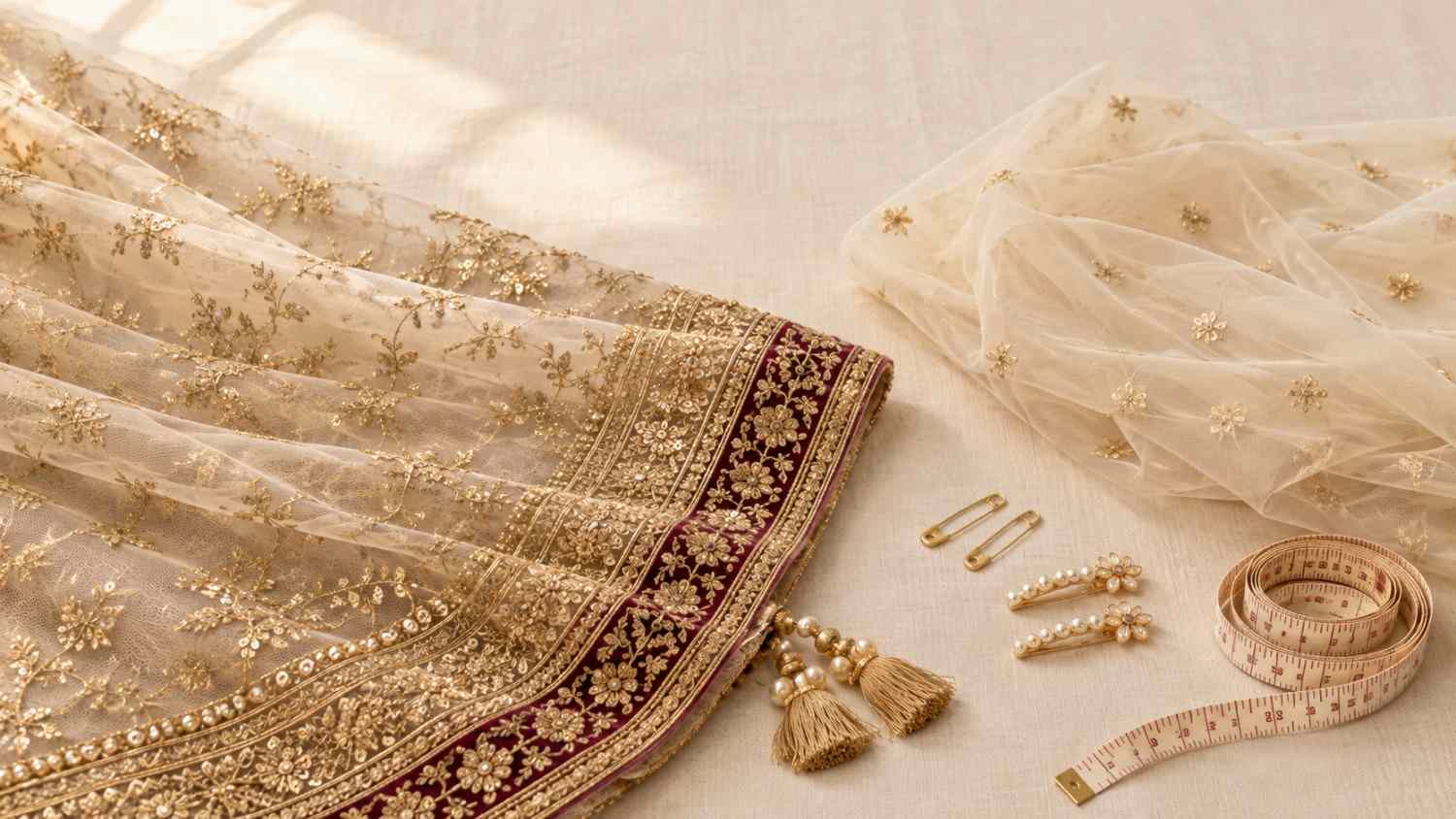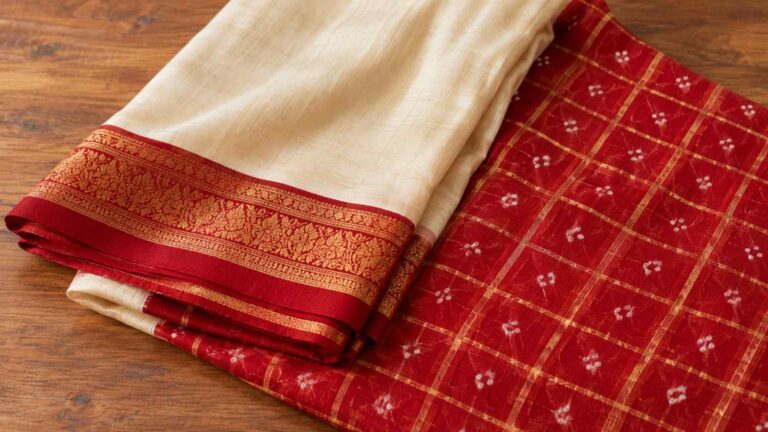
The Panetar and the Gharchola are the two traditional bridal pieces of a Gujarati wedding, one from each side of the family. The Panetar is a white or off-white saree with a red border. The Gharchola is a red Bandhani piece with a gold zari grid. In many accounts the bride’s maternal uncle gives the Panetar and her in-laws give the Gharchola. You will also see the spellings Paneter and Gharcholu.
Published accounts describe the Gharchola today as an odhani (the Gujarati word for dupatta) worn over the head and shoulders, on top of the Panetar. You can honour the same tradition in a lehenga or chaniya choli.
Wear a Panetar-style lehenga, put a Gharchola odhani over any bridal lehenga, or do both. Which one fits depends on what your two families expect and which pieces they are giving. The first job is to find that out before anything is designed.
Panetar and Gharchola at a glance
| Feature | Panetar | Gharchola |
|---|---|---|
| What it is | A bridal saree with a white or cream body and red or maroon borders and pallu, often with zari lines | A Bandhani piece with a grid of squares, each bordered with zari and holding a tied motif |
| Usual colours | White or off-white with red or maroon; some accounts note green accents | Usually red; green versions are described |
| Reported giver | The maternal uncle in many accounts; the bride’s parents in a documented 1998 case | The groom’s family, often the mother-in-law |
| How it is made | Traditionally Gajji silk with gold zari stripes or checks; the base cloth may be machine-woven with hand-done embellishment | Hand-tied Bandhani with zari; traditionally cotton or silk-cotton, now also silk and georgette |
| Commonly described use today | The ceremony outfit, as a saree or a Panetar-style lehenga | An odhani over the head and shoulders, or a saree in the older sequence |
Why a bride wears two pieces
The V&A holds a Panetar and Gharchola worn at a Hindu wedding in London in 1998. The bride wore a Panetar given by her parents and a Gharchola given by her new in-laws, both bought in Gujarat.
The museum’s reading, in its wedding colour article, is that wearing the two sarees together lets both sets of parents symbolically invest in the marriage. It also notes that red is a popular bridal colour in India because it is thought to signal future success and prosperity.
The Gharchola’s name is read two ways. A common gloss is “outfit for home”, for a bride joining her new home. A craft encyclopedia entry, quoting the textile scholar Lynton, says “ghar” means house but also suggests birthplace or family, and proposes that the piece may come from the bride’s own home.
The etymology is unsettled, but both readings describe a piece tied to a home. The pair is as much about two families being visible on the bride as it is about two textiles.
Where the published accounts disagree
Read a few guides and you will meet contradictions. Most reflect different families, regions and eras, not errors. The table draws on a retail-affiliated encyclopedia (Utsavpedia), the Asia InCH craft encyclopedia, the V&A, a government craft portal and wedding sites. Use it to decide what to ask at home.
| Point | What the accounts say | What to ask |
|---|---|---|
| Who gives the Panetar | Utsavpedia names the maternal uncle. Asia InCH says so only in some parts of Gujarat. The V&A’s documented case has the bride’s parents | Who is giving it, and when? |
| When each is worn | Asia InCH says the Gharchola was once a separate attire for a different ceremony. One wedding guide has the Panetar at the start and the Gharchola in the last leg. The government portal says some families still expect an immediate change, while many brides now layer the Gharchola over the Panetar | Which moment does each piece belong to? |
| Gharchola colour | Khamir describes a red odhani with white, green or yellow dots. Pernia’s Pop-Up Shop says it usually comes in green. Asia InCH says red is most common, green is possible and yellow can stand in for green | What colour is ours? Can we see a photo? |
| Panetar border | Red today. Utsavpedia, Asia InCH and a wedding guide say it was once green, with saffron or yellow in between | Is a touch of green acceptable to our family? |
| Fabric | Utsavpedia says the Panetar was traditionally silk and the Gharchola cotton, and that the distinction has lapsed. Asia InCH names Venkatgiri cotton or a silk-cotton blend for the Gharchola. The government portal says it is now woven in silk and georgette as well | What is it made of, and how heavy is it? |
| Where the Gharchola is made | The government portal says the weaving technique came from Cambay, with hand-woven cloth sent from Porbandar to Jamnagar for Bandhani. Utsavpedia says the cloth is tied in Kutch and dyed in Jamnagar. Asia InCH says Khambhat and Jamnagar | Where was it tied and dyed? |
| What “9, 12, 52” means | Utsavpedia calls them zari grids on a vertical row. Asia InCH describes squares in multiples of 9, 12 and 52, naming the 12-square grid bar bagh and the 52-square grid baavanbagh | Treat them as pattern names and confirm with the seller |
| Which dupatta is which | Utsavpedia describes a Panetar lehenga with two dupattas, one white-and-red and one the Gharchola. A 2010 blog describes a heavy shoulder dupatta and a lighter head dupatta, and calls the lighter one the Gharchola | Name each piece by its role when you brief a maker |
The practical lesson is not to plan from a single account. Plan from your family’s answers.
Five ways brides wear them today
The first two setups are saree-based. The last three involve a lehenga or chaniya choli. If those words overlap for you, our explainer on lehenga, ghagra and chaniya choli sorts out the vocabulary.
| Setup | What the bride wears | Suits you if | Check before ordering |
|---|---|---|---|
| 1. Two sarees in sequence | Panetar first, then a Gharchola saree later | Your family expects the older sequence | Who drapes each, and how long the change takes |
| 2. Panetar saree with a Gharchola odhani | The Panetar on the body, the Gharchola over head and shoulders | You are comfortable in a saree for hours | The Gharchola’s length and weight on your head |
| 3. Panetar-style lehenga or chaniya choli with two dupattas | A white lehenga with a red border, usually a red blouse, a white-and-red dupatta and the Gharchola | You want the Panetar colours without the saree | Who supplies which dupatta: your maker or the families |
| 4. Any bridal lehenga with a Gharchola odhani | A lehenga in any bridal colour, with the in-laws’ Gharchola over it | You want a different colour but still want the gift visible | Whether the lehenga’s colours sit well with the Gharchola |
| 5. A lehenga for most of the day, the Panetar worn or draped for one part | A lehenga, with the Panetar put on for a ritual moment | One planner’s guide says many families still ask for this when the bride chooses a lehenga | When and where the change happens |
Moving to a lehenga is not new. A 2019 WeddingWire article reported that many Gujarati brides were turning from sarees to lehenga cholis, and described an odhni depicting the Panetar worn over a designer lehenga.
A 2026 Brut report on a celebrity wedding followed setup 4, describing a Bandhani Gharchola dupatta worn as a tribute to the family the bride was marrying into.
Ask both families before you design anything
- Which pieces will you be given, by whom, and when will they reach you?
- Which moment of the wedding does each piece belong to?
- Must the Panetar itself be worn or draped, or is an odhani enough?
- What form and colour will the Gharchola take?
- Does your family tie anything together, such as the Gharchola to the groom’s shawl?
- Who will drape the pieces on the day, and can that person attend the final trial?
Wearing a Panetar-style lehenga or chaniya choli
Colour. The classic is a white or off-white body with a red border, usually with a red blouse. One retailer’s guide suggests deep green, red or gold blouses and notes that modern brides also try pastels. Green has precedent, since the Panetar’s border was once green, as the table above shows.
Fabric. Panetars were traditionally made in Gajji silk with thin gold zari stripes or checks. A lehenga can use lighter fabrics. WeddingWire notes that pure silk is hard to manage where summers are extreme, and that Panetars now come in chiffon, georgette and tissue. Our comparison of silk and organza lehengas explains how each behaves over a long day.
Dupattas. A Panetar lehenga is usually described with two dupattas, so settle how many pieces you need and what each does before anything is made. Keep whatever sits on your head light.
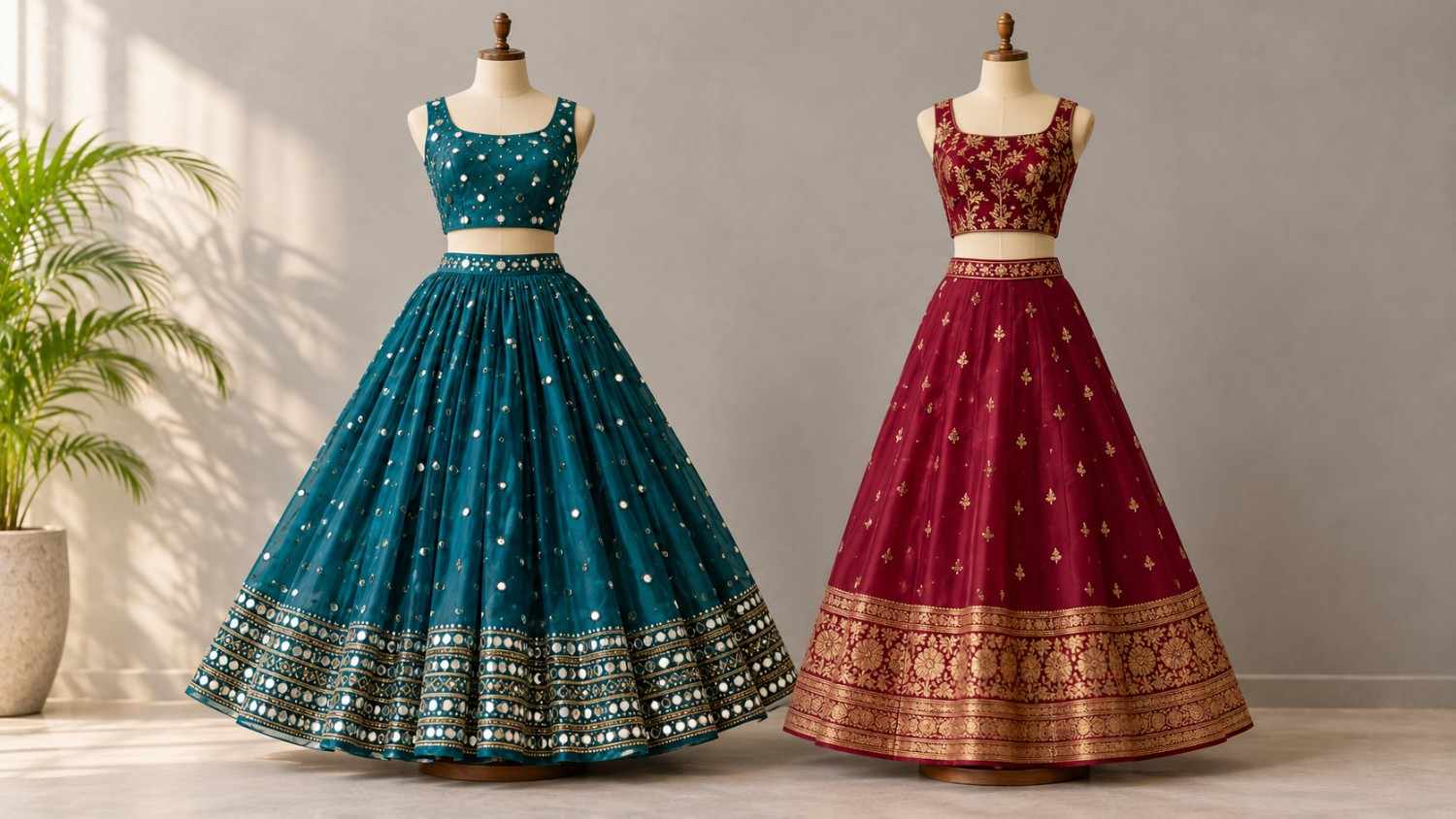
A word about the name. Retailers use “Gujarati bridal chaniya choli” for a different outfit. One listing describes it as mirror work, Bandhani or Patola, which is not a Panetar chaniya choli. When you brief a maker, say “Panetar-style” and describe the colours and the dupattas.
Designing around a Gharchola you didn’t choose
The Gharchola is usually the in-laws’ gift, so you may be designing before you have seen it. Decide things in the right order.
- Match closely or contrast clearly. Two near-but-different reds side by side can clash. Either match closely or choose a clearly different body colour, such as ivory.
- Let the Gharchola carry the richness. It already has a zari grid and tied motifs. Keep your own dupatta supportive and put the richest work on the blouse or border. Our guide to heavy versus light embroidery explains how to balance it.
- Check the weight. Ask what the Gharchola weighs before it sits on your head, since the cloth ranges from cotton blends to silk and georgette.
- Choose the blouse last. Asia InCH notes that contemporary Gharcholas sometimes carry a separate green border and pallu, so wait until you have seen the piece.
A hypothetical example, for illustration only. A bride plans an ivory lehenga with a red border (setup 3). Her in-laws will give a red Gharchola, so she asks for a photo before choosing a blouse.
It arrives with a green edge, so she picks a green blouse and the two pieces read as a pair. A different Gharchola would lead to a different choice. The point is to decide the blouse and dupatta late.
If you are also coordinating with the mothers’ outfits, our guide to what the mothers wear at a Gujarati wedding covers colour around the Panetar and Gharchola.
Wearing the Gharchola with a lehenga
Published accounts agree on the basics: the Gharchola goes over the head and across the shoulders. The Asia InCH craft entry adds that in the practice it describes, the Gharchola is tied to the groom’s shawl in an auspicious knot. Beyond that, descriptions of the drape are thin and differ, so treat the steps below as things to test, not as one correct drape.
- Use the real Gharchola, or a cloth of similar length and weight.
- Dress fully, with the blouse, lehenga, jewellery and hairstyle.
- Place it over your head and shoulders and choose more than one anchor point, at the hair and the shoulder. Pin away from embroidery so you do not snag it.
- Sit as you would for the rituals, stand for ten minutes, and climb steps.
- If your family ties it to the groom’s shawl, rehearse that and check it can be released without disturbing the head piece.
- Photograph the front, side and back.
Our bridal dupatta draping guide explains the stand-in cloth method for testing length and placement before the final piece is ready.
Buying or commissioning genuine pieces
The Gharchola is a registered Geographical Indication. The IP India registry record lists “Gharchola Craft of Gujarat” as registered, with a certificate dated 30 March 2024 and the Gujarat State Handloom and Handicrafts Development Corporation as applicant.
News coverage clusters around the formal presentation on 29 November 2024, which is why you will see both dates. A GI generally ties a product name to a place and a defined standard. It does not tell you whether a particular seller’s piece qualifies, so ask for documentation.
Questions to ask a seller:
- Is the Bandhani hand-tied or printed? Our craftsmanship guide explains how to tell, including checking the reverse side.
- Where was it tied and dyed?
- What is the base fabric?
- What documentation supports any GI claim?
For a Panetar, the base cloth may be machine-woven with hand-done embellishment, so ask which parts are handwork. No published prices were found, so ask for an itemised quote.
Fashion Autograph’s general care advice for delicate embroidered pieces is to hand wash or dry clean, store flat or hung properly and avoid direct sunlight. For a Gharchola or Panetar, ask the maker for fabric-specific instructions.
Situations that need a different plan
- Your family follows a different custom. Khamir’s online Bandhani exhibition describes the Gharchola as made for Hindu and Jain brides. Practice varies within and beyond those communities, so ask your elders first.
- You are marrying into a Gujarati family from another community. The Gharchola may be offered as a welcome, as in the 2026 example above. Agree beforehand what will be worn and when.
- The maternal uncle cannot attend. One planner’s guide says another member of the maternal family usually takes his place for the mameru. Ask who will give the Panetar.
- You live abroad. The V&A case had both sarees bought in Gujarat for a London wedding. Our guide to ordering a bridal lehenga from abroad covers measuring, fittings and shipping.
- You own an heirloom Panetar or Gharchola. Bring it to your maker early. A 2026 Brut report on a celebrity wedding built the lehenga around a family heirloom dupatta.
When to start
Fashion Autograph’s bridal page recommends booking a bridal lehenga about two months before the wedding. Allow longer for heavy embroidery. One planner’s guide says the maternal uncle often buys the Panetar months ahead and brings it a day or two before the wedding, so confirm each piece’s timing with your family. Our bridal lehenga buying guide covers the wider decisions, including what to ask about fittings and delivery.
A workable sequence:
- Ask both families the questions above as soon as the date is fixed.
- Get a photo or swatch of each gifted piece as soon as it is bought.
- Finalise the blouse and dupatta once you have seen them.
- Trial with the real pieces, or close stand-ins, and bring the person who will drape them to the final trial.
Planning with Fashion Autograph
Fashion Autograph designs bridal outfits to measure in Ahmedabad, with coordinated dupattas and complimentary fittings. If you are planning a lehenga around a Panetar or Gharchola, a consultation is the place to settle the setup. Bring:
- a photo or swatch of the gifted pieces, or the colour family your families expect;
- your answers to the six questions above;
- your blouse and jewellery ideas;
- your wedding date and the functions you are dressing for.
Browse our bridal lehenga designs or book a consultation.
Frequently asked questions
Can I wear a Gharchola over a lehenga?
Yes. It is commonly worn over the head and shoulders. Test its weight, plan your colours around it, and ask whether your family ties it to the groom’s shawl.
Does a Panetar have to be white and red?
The traditional description is a white or off-white body with a red or maroon border. Accounts also mention green accents and modern pastel versions. If your family expects the traditional look, ask before departing from it.
What if the Gharchola arrives after my lehenga is designed?
Leave the blouse and dupatta decisions open until you have a photo or swatch, and ask for it early. A neutral body colour gives you more room to adapt.
Is the Gharchola GI-registered?
Yes. The registry lists a certificate dated 30 March 2024, and the tag was formally presented in November 2024. Ask any seller what documentation backs a GI claim.