Choose the drape from the facts of your wedding day: how long you will wear it, how hot the venue is, whether you will sit on the floor or dance, and what your family expects. Then let the drape decide the dupatta: how many pieces, how long and wide, how heavy, which fabric, and where the embroidery should sit.
Three rules cover most brides. Keep whatever sits on your head light. Put the richest work where the drape leaves it visible. Measure the drape with a stand-in cloth before the real dupatta is made.
Many guides to bridal dupatta draping end at the photograph. Weddings go wrong a step later. A dupatta chosen for how it looks on a hanger can turn out too short for the drape you wanted, too heavy for your head, or embroidered where the pleats will hide it. This guide starts with your day, shows eight drapes, and ends with what to tell a maker so the dupatta fits the drape.
What a bridal dupatta has to do
The dupatta frames your face when it is worn over the head, adds volume and richness, gives coverage when a ritual calls for it, and carries embroidery that is photographed closer to your face than anything on the skirt. A few terms recur below:
- Body: the main field of the fabric.
- Pallu: the decorated end, usually the part on show.
- Border: the worked edge along the length or the ends.
- Facing or lining: the underside. It shows wherever the dupatta folds or frames your face.
- Corners: the ends of the fabric, which can carry tassels or small weights.
- Drape versus dupatta: the drape is how you wear it, and the dupatta is what you order.
Step 1: Start with your day, not the photograph
Photographs show the finished moment, not the hours behind it. These six questions narrow the choice before you look at a single drape.
| Question | Why it matters |
|---|---|
| How long will you wear it? | A long day rewards drapes anchored at more than one point. A short entrance can use a freer drape. |
| What will you do in it? | Floor-sitting rituals, steps and dancing each stress a drape differently. Test all three. |
| How hot is the venue? | Two pieces mean more fabric on you. Fabric choice matters more as the temperature rises. |
| What does the rest of the outfit show? | A detailed blouse back or neckline may want to stay visible. See the work behind our designer blouses. |
| What is your hair doing? | A bun, open hair or a headpiece decides where the dupatta can be anchored. |
| What does your family expect? | Some families expect a head covering or a particular ceremonial dupatta. See the Gujarati section below. |
Three rules that hold for most drapes
- Light on the head. Your hair and pins carry whatever sits on your head. A lighter dupatta made for the head is a long-standing suggestion when the one that comes with the lehenga is heavy.
- Richness goes where the drape shows it. When a dupatta is pleated, much of its width folds into the pleat band, so the border and the ends show more than the field does.
- If you take two, shorten each. A standard dupatta is sized for one, so each of a pair is normally made shorter. WedMeGood’s bridal dupatta advice makes the same points about head weight, paired length and the lining, though it dates from 2017 and cites no measurements.
Heat. IMD’s climate summary for Ahmedabad describes a hot, semi-arid climate with an average maximum of about 30°C from November to February. Summer weddings are much hotter, and every extra layer counts. Our guide to summer wedding fabrics covers what stays comfortable.
A quick chooser
These are starting points to test, not rules.
| If this describes your day | Start by testing | Pieces |
|---|---|---|
| Long ceremony in hot weather | Head-and-shoulder or cape in a light fabric | One light piece, or two very light ones |
| Floor-sitting rituals | A drape anchored at the head and one shoulder | One, or head plus body |
| Dancing or a sangeet | Cape or belted drape, where the anchoring does the work | One |
| Heavily worked skirt | A lighter dupatta and a drape that shows the blouse | One light piece |
| Lightly worked lehenga that needs richness | Front pallu or saree style with a worked body dupatta | One rich piece, plus a light head piece if expected |
| Family expects a ceremonial piece | Plan the dupatta around it | Often two |
| Open hair, long entrance | Trailing drape or cape | One, very light |
Step 2: Eight bridal dupatta draping styles, and what each asks of the dupatta
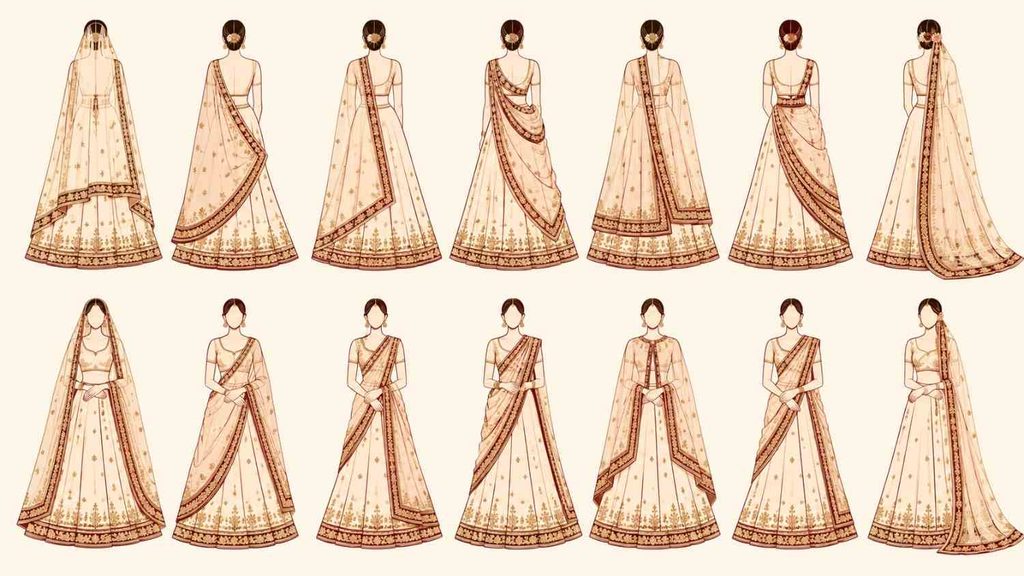
These are described by how the fabric sits, not by region. A drape named after a place can mean different things in different guides.
1. Head and shoulder
The dupatta is centred over the head, anchored at the crown or hairline, and brought forward over the shoulders. Suits: ceremonies where you want a frame around the face, and dupattas whose border is the feature. Trade-off: it partly covers the neckline and necklace, so check it against your bridal jewellery, and your head carries the load.
2. Light veil plus body dupatta
A light dupatta covers the head. A second, richer piece is pleated onto a shoulder or brought across the body. Suits: the main ceremony, when you want coverage and display together. Trade-off: more fabric and weight, and the two pieces must agree on colour and work.
3. Front pallu
The dupatta comes from behind over the right shoulder and falls across the front with the decorated end facing forward, usually pinned at the shoulder and often tucked at the waist. Suits: a richly worked pallu, and families who expect this drape. Trade-off: it covers part of the front of the blouse, and it is a saree drape adapted to a much shorter piece of fabric.
4. One-shoulder pleated
Pleated and pinned at one shoulder, with the rest falling to the front, the back or both. Suits: receptions and engagements, and any look where the blouse and necklace should stay visible. Trade-off: fluid or heavy fabric can slide, so use more than one anchor point.
5. Cape
Pinned at both shoulders and falling down the back. Suits: dancing, entrances and photographs from behind, leaving the front open. Trade-off: it hangs from two pins, so width and weight matter, and the back view deserves as much attention as the front.
6. Belted
Pleated and secured at the waist with a belt (kamarbandh). Suits: long days and dancing. Trade-off: it adds a load at the waistband, which already carries the skirt. Ask how quickly it comes off for breaks.
7. Saree style
One end is tucked at the waist, the fabric wraps across the body and goes over a shoulder like a pallu. Suits: formal looks and wide borders that should show along the wrap. Trade-off: it needs more fabric and a fabric that holds pleats, and it adds bulk at the waist.
8. Trailing from the hair
Anchored at the bun or crown and left open behind you. Suits: open hair or a low bun, long entrances, and a blouse you want visible. Trade-off: your hair carries all of it, so the fabric must be light.
Gujarati brides: front pallu, Panetar and Gharchola
If your family follows Gujarati bridal tradition, part of the dupatta may already be decided. Know what is involved before you commission anything.
According to Utsavpedia’s account of the Panetar, the Panetar is a ceremonial saree with a white body and a red or maroon border and pallu, given to the bride by her family. It is usually accompanied by a Gharchola from the groom’s family. The gifting is practised in parts of Gujarat that include Ahmedabad.
Historically the bride wore the Panetar for the first half of the ceremony and changed into the Gharchola for the second half. Today, Utsavpedia says, a Gharchola dupatta over the head and shoulders on top of a Panetar is common.
It also describes a Panetar lehenga worn with two dupattas, one white-and-red and one the Gharchola. The same page says Gujarati sarees are worn with the pallu taken from back to front over the right shoulder, which is the front pallu drape above.
This is a useful reference but not a rulebook. The page dates from 2015 and is published by a clothing retailer, and practice varies by family and community. Other communities have their own conventions, so ask your elders:
- Which piece is expected, and who gives it?
- When is it worn, and does it cover the head?
- Does it sit over or under the other dupatta?
Settle those answers before you finalise the number of pieces, because they change every figure in your specification. Our post on Gujarati craftsmanship explains the Bandhani tradition behind these pieces.
Single dupatta or two pieces
Decide this early, because it changes every number in your specification.
| Factor | Single dupatta | Two pieces (head plus body) |
|---|---|---|
| What each does | One piece covers everything you want covered | The head piece frames and covers; the body piece carries the richness |
| Suits | Shorter functions, simpler lehengas, brides who want the blouse and skirt to lead | Main ceremony, plain or lightly worked lehengas that need richness, family expectations |
| Weight | Whatever is on your head is also on your shoulders | Weight can be split; keep the head piece light |
| Heat | Fewer layers | More fabric on you, so go light |
| Watch for | A heavy piece on the head | Both pieces heavy, or both too long |
A lightly worked lehenga can look richer with a worked body dupatta. A heavily worked one often looks better with a quieter dupatta. Our guide to heavy versus light embroidery explains how to balance work across the blouse, skirt and dupatta.
Step 3: Turn the drape into a dupatta specification
A specification has seven parts: number of pieces, length, width, weight, fabric, where the work sits, and finishing (facing, corners, border).
What published sources say about length
The published guidance is inconsistent, and none of it says which drape the number is for.
| Source | Figure |
|---|---|
| Aza Fashions, guide to dupattas | 2 to 2.5 m |
| WedMeGood (2017) | About 2.5 m for a single dupatta |
| Weaverstory | 2.5–3 m for lehenga draping |
| One marketplace sequin dupatta listing | 94 in × 36 in (about 2.4 m × 0.9 m) |
| Aza, heritage-drapes article | About 6 m for the Khada style |
These are published claims, not independently verified, and I found no published weights for bridal dupattas. Treat them as a range of what is on the market, not a standard.
Measure it yourself: the stand-in method

You do not need a maker’s measurements to learn what a drape needs. You need a plain cloth of known length, a tape measure, a helper, and ideally your real blouse, jewellery and hairstyle.
- Take a plain, light cloth, such as a cotton or muslin length or a dupatta you own. Note its length and width.
- Drape each shortlisted style with the helper, wearing the real blouse.
- Clip the cloth where the drape is secure. Measure how much length the drape used.
- Measure the front drop and the back drop from the shoulder to the end of the cloth.
- Note where the pallu lands (waist, hip or knee) and how wide the pleat band is.
- Note any shortfall or spare tail.
If the stand-in leaves a long spare tail in the one-shoulder drape but runs short in the saree-style wrap, you have learned that the wrap needs a longer dupatta. Take your numbers to the maker as evidence, not as a final specification. A stand-in tests length and placement, not fall: a net stand-in will not hang like the final silk, and the maker will adjust for fabric, pleating and finishing.
What each drape asks for
These are starting points drawn from how each drape works. They are not measured studio data. Confirm everything with the stand-in method and the maker.
| Drape | Pieces | Length (vs a standard single) | Weight to ask for | Fabric behaviour | Where the work should show | Main anchor |
|---|---|---|---|---|---|---|
| Head and shoulder | 1 | Standard | Light to medium | Soft fall | Border framing the face | Hair pins |
| Light veil plus body | 2 | Shorter for each | Head light, body medium | Head sheer; body holds pleats | Body: border and pallu | Hair and shoulder |
| Front pallu | 1 (plus head piece if expected) | Enough to show the pallu | Medium | Holds pleats and falls cleanly | Pallu | Shoulder and waist |
| One-shoulder pleated | 1 | Standard | Medium | Holds pleats | Border along the pleats | Shoulder, ideally two points |
| Cape | 1 | Standard; width matters | Light to medium | Falls straight and flat | Work visible from the back | Both shoulders |
| Belted | 1 | Standard | Light to medium | Holds pleats | Border between pleats | Belt |
| Saree style | 1 | Longer than standard | Medium | Holds pleats | Wide border along the wrap | Waist and shoulder |
| Trailing from hair | 1 | Standard or longer | Light | Light and fluid | Edges and corners | Hair |
Reading the specification
- Weight. Ask for each dupatta’s weight in grams, and whether it includes the facing and tassels.
- Where the work sits. Because pleating folds the field, concentrate density in the border and pallu. Our embroidery guide explains which techniques add the most weight.
- Facing. Choose it deliberately. It shows against your face and in photographs.
- Pleating. Ask whether the pleats will be set or whether you will pleat the dupatta on the day.
A worked example (hypothetical): a bride has a December evening wedding indoors and a heavily worked skirt. Her family expects a front pallu and a head covering.
A workable plan is two pieces: a medium-weight, pleat-holding body dupatta with its work concentrated in the pallu and border, plus a light net head piece with a narrow border. Because there are two, she specifies each shorter than a single.
Fabric by drape and by heat
| Fabric | General behaviour | Good for | Watch for |
|---|---|---|---|
| Net | Light, sheer | Head pieces, veils | Needs anchoring like any light fabric |
| Organza | Crisp, holds shape | Structured shoulder and cape drapes | Can feel stiff |
| Georgette and chiffon | Fluid | Cape and trailing drapes | Slides |
| Silk and raw silk | Rich fall | Body dupattas | Smooth silk can slip |
| Banarasi and brocade | Structured | Front pallu, saree style | Weight adds up on the head |
| Velvet | Heavy | Winter weddings | Pulls on hair if worn on the head |
This is general behaviour, so test your own swatch. A useful principle from NDTV Shopping’s guide to heavy dupattas is to choose a drape that matches the dupatta’s weight. Our silk versus organza guide compares how these fabrics behave over long hours.
Keeping it in place
Match the anchoring to the fabric’s weight, and anchor at more than one point. Pin away from embroidery, so you do not snag it. Place jewellery after the dupatta is set. David’s Bridal’s dupatta draping guide lists dupatta weights among its practical kit, which suggests the idea is worth discussing with your stylist.
Test the drape before the dupatta is final
Plan on fixing the number of pieces, the weight and the placement of the work no later than fabric approval. This is a sensible rule, not a universal one, so confirm your boutique’s cut-off dates. Our guide to what to ask your bridal boutique before booking covers fittings and policies.
| Stage | What to settle for the dupatta |
|---|---|
| Brief and sketches | Function list, drape shortlist, number of pieces |
| Fabric approval | Fabric, weight, facing, where the work sits |
| Production | Nothing should change |
| Trials | Test the drape with the real dupatta, or a similar-weight stand-in |
| Final trial | Pins, pleating, and how it comes off |
Trial checklist
- Dress fully, with the real blouse, jewellery, shoes and hairstyle.
- Drape each shortlisted style and photograph the front, side and back.
- Stand still for ten minutes and notice where it pulls.
- Sit as you would for rituals, on a low seat or floor cushion.
- Climb stairs, get into a car and raise your arms.
- Move for a minute, then stay in it for 20 to 30 minutes.
- Ask how it comes off and goes back on for breaks.
- Decide who will drape it on the day, and have that person attend the final trial.
How to brief a maker, and order from a distance
| Tell them | Ask them |
|---|---|
| Your function list and which function this dupatta is for | The dupatta’s length, width and weight |
| Your drape shortlist: a main choice and a backup | Whether the quote itemises the dupatta, its finishing and any extra piece (our buying guide lists dupatta finishing among the costs brides discover late) |
| Your hairstyle and headpiece | How many fittings include the dupatta |
| Your blouse neckline and jewellery | Whether it can be tested on a dress form first |
| Your family’s expectations | The cut-off dates for changes |
Choose a specification that supports two drapes. A dupatta made for your first choice will usually support a related backup, but rarely an unrelated one.
If your lehenga is already made, the same principles apply: bring the lehenga’s colour and weight, your drape shortlist and your stand-in measurements to whoever makes the dupatta.
Ordering from abroad. The process in our guide to ordering a bridal lehenga from abroad applies here too. Send reference photos and your stand-in measurements, and ask for the specification in writing.
Common mistakes
- Choosing the dupatta before the drape.
- Putting a heavy dupatta on the head.
- Making both pieces of a pair full length.
- Hiding the blouse or necklace under a pallu you wanted to show.
- Never sitting or climbing stairs in the drape before the trial.
Planning your dupatta with a bespoke lehenga
Fashion Autograph designs bridal outfits to measure in-house, and our bridal lehenga page notes that we provide coordinated dupattas. If you are planning a custom bridal lehenga, bring your drape shortlist and function list to a consultation so the dupatta is planned with the lehenga, not added at the end. Contact us to book one.
Frequently asked questions
How long should a bridal dupatta be?
Published figures cluster around 2 to 3 m for a single dupatta, with no agreed standard. The right length depends on the drape and the number of pieces, so use the stand-in method above and shorten each piece if you take two.
Is a single or double dupatta better for a summer wedding?
Fewer layers help in heat. A single light piece, or two very light ones, usually works better than a heavy pair.
Can I change the drape after ordering the dupatta?
Often within limits. The length, width and weight you order decide which drapes are possible, so choose a specification that supports your first choice and a backup.
Can I order a dupatta separately from the lehenga?
It depends on the maker. Ask whether they make standalone dupattas, and bring the lehenga’s colour, weight and your measurements.